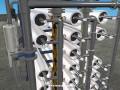
If you believe what the many of these marketers of residential reverse osmosis systems are saying, you would think that these residential reverse osmosis systems were a revolutionary piece of equipment at your fingertips. The only problem is that the reverse osmosis systems residential benefits have not exactly been what people are expecting.
Residential reverse osmosis systems are revolutionary only because they are the first reverse osmosis systems built for home-use instead of industrial usage. Reverse osmosis has been the primary standard of water treatment in the industrial world for nearly a century. It's primarily used in order to keep mineral deposits from forming in machines such as boilers.
Reverse Osmosis systems for residential use has only recently begun and is currently being explored. It's been touted as a water purifying system that is a scaled down version of the filters used at treatment facilities. And the filtering system even at the level at water treatment plants still leave a lot to be desired in terms of water treatment.
And as much as its touted as revolutionary, residential reverse osmosis systems are relatively new but based on an older system. In fact, they have been utilized for water treatment for over a century. They were first introduced in order to slow down waterborne disease mortality and moderately worked well. It wasn't until chlorine was first introduced in 1908 that the apparatus began to show its effectiveness.
The problem with reverse osmosis is that it was never designed to be primarily as a cleaning apparatus. The porous membrane filters used were primarily for demineralization purposes and were not for the removal of anything smaller or lighter than a water molecule. What that means is there is a chance that microscopic compounds can get into your drinking water. Unfortunately, many owners of residential reverse osmosis systems aren't finding out until after the fact.
There are many toxic chemicals flowing in our drinking water today and they flow through the filters from reverse osmosis systems. Bacteria and other small contaminants escape through these membrane filters and enter the water system. And now the primary worry by the owners of these costly systems is that their system is helpless in removing these contaminants.
It would be a safe assumption that if the reverse osmosis system at a water treatment facility failed in its mission to halt the flow of these toxins, that residential reverse osmosis systems don't stand a chance at stopping these contaminants at all. That is because the reverse osmosis system is really only the first stage of what needs to be a multi-pronged attack in combating these micro contaminants.
Had many of the reverse osmosis systems residential owners done their research before they bought their unit, they would have known that these costly systems are not what they needed. They would have realized that there are whole house and point of use filtering systems that they could have gotten at a fraction of the price that they paid for these residential reverse osmosis systems
So, residential reverse osmosis systems is definitely not the answer for pure, clean drinking water. What is necessary in combating the chemicals in your drinking water is the combination of an activated carbon filter and a multi block filter. In addition, a purchase of a sub-micron filter and an ion exchange unit, and you will be on your way to having pure, safe drinking water minus the contaminants.