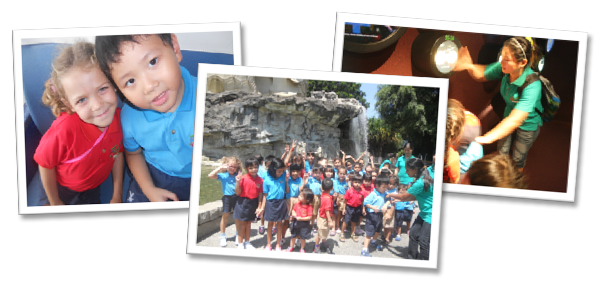
Integrated Language Arts - Creative LanguageUsing thematic approach to develop their language skills and abilities as they explore topic and resources that are interesting and meaningful to them.
 Mandarin - Hanyu Pinyin & Chinese Speech & Drama
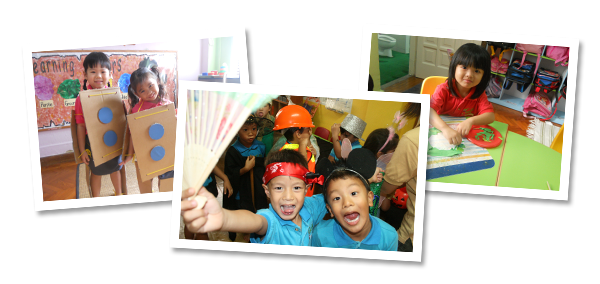
Role-plays and dramatization provide children the opportunity to express their thoughts and feelings. They will acquire the ability to articulate themselves, learn accurate speech, patterns different intonations and achieve an improved vocabulary.
Conceptual MathematicsMathematical concepts are introduced in a concrete and meaningful way. Children will have the opportunities of hands-on experiences with materials, which will become their foundation for more complex and abstract mathematical work for later learning.
Arts & Music AppreciationExposure to various forms of arts, this will enable children to develop fine and gross motor skills, eye and hand coordination. Through art children will also learn concepts such as colour, size, shape, forms and texture. Music, singing and dancing draw satisfying expressions of emotions and pleasure. These activities will help to build up their self-esteem. Children will also learn auditory discrimination of different sounds, melody and rhythm.
Life Skills - Montessori Application (Practical Life Skills, Sensorial, Mathematics, Language)Montessori TermsAbsorbent Mind
The ability and ease with which young children learn unconsciously from his or her environmentThe environment lays the foundation for the Montessori programme. Uniqueness and individuality are the dominant themes. Within, the four areas of development are emphasized: practical life experience and character building. Activities are programmed in small sequential steps and each activity is designed to foster development in a particular area. For instance, exercises in daily living such as hoe polishing, floor sweeping encourage self-care skills and competence in daily activities. Positive human interactions encourage human character building. The manipulation of specially designed and structures learning materials promote body coordination and sensory and conceptual development.
The Montessori programme provides the child with real work using real materials.
Practical Life:An Adult works to perfect the environment…….
A child works to perfect himself ………
Sensorial:In the word of the child:” I hear and I forget, I see and I remember, I do and I understand”
Conceptual (Academic Materials) - Math & Language
A child works to perfect himself by manipulation and understanding how each material I designed for a specific purpose.
 Library
The centre will encourage and motivate children into reading and as part of the curriculum children will be encouraged to bring a book home for fun reading with their parents. This is to build bonding with child and parent. Children will be allowed to pick a book from the library on a weekly basis.
Phonics - Nursery One to Kindergarten 2Phonics is the silence of sound which teaches beginners to read and pronounce word by learning the sounds and letters and letter groups.
The sounds of letters and letter combinations are introduced to the children before each group of words is introduced. The approach would also enable children to “decode” words and hence to “read”.
This method enables children to develop a “reading vocabulary”
Speech, Dance, Drama & PoetryChildren learn through drama and play. They learn to read by reading. They learn to write by writing and they learn to talk by talking.
Drama is one lesson in curriculum where children have ample opportunities to practice listening and speaking and with this opportunity to play with language, children will grow up to be more articulate.
Drama can fit anywhere,) example: early in the morning, into a social studies lesson into a lesson on word families, into adding and subtracting money.
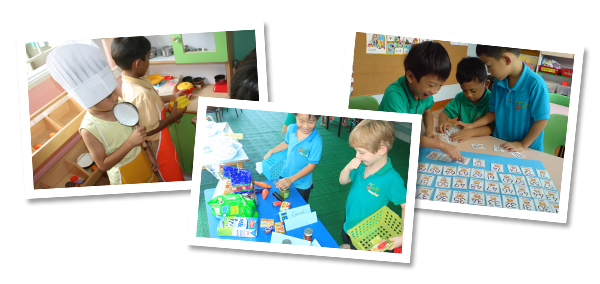
Life SciencesIncludes cookery, social, moral and environmental Studies Science & Experiments:Through exploring, observing, questioning and experimenting, children learn to understand and clarify cognitive concepts. It sharpens children’s perception in discovery and stimulates their natural curiosity. This satisfies their intrinsic desire to learn about the world.
Cooking and Hands-On Experience:Through cooking, children learn motor coordination, cognition, social and language skills. It also helps them to identify with home activities. Self concept is enhanced as they experience the feeling of success and have fun at the same time.
Preparation for Primary One - For Kindergarten 2Childhood is not only a period of rapid development but is also very complex. Researcher and educators have repeatedly stressed the crucial importance of early childhood experiences. These influences not only affect their later functioning in school but also have effects throughout their lives. Young Children need positive, supportive relationships not only for cognitive development but also for healthy emotional, physical and social development. Children at this stage are confident, independent and mature; learning I so rapid, that it is very important and crucial to prepare our children for the next level. In order to build a firm strong foundation we need to encourage and motivate learning. The curriculum will consist and comprise the primary one syllabus designed by MOE standards.
Comprehensive Reading Program - From N1 to K2Children need to know what reading is, that is, meaningful communication between writer and reader. Children should understand that what they say can be written down and what can be written down can be read by others. Children need to know what a letter is, what a word is. They need to know that we read from left to right, top to bottom, from a page on the left page on the right. They need some knowledge of punctuation marks, such as, the full stop, comma, question mark, in order to be able to read meaningfully with the correct intonation.