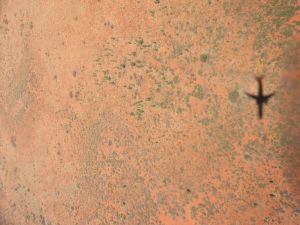
Ayers Rock is undoubtedly one of Australia's most widely recognised icons both nationally and internationally. It is also one of Australia's most popular tour destinations, and for very good reason. Set in the stunning red desert landscape of Central Australia, it is a magnificent and magical sight that should form part of any Australian tour itinerary.
Also known as Uluru, Ayers Rock is located within the Uluru Kata Tjuta National Park about 400 kilometres southwest of Alice Springs in the Northern Territory of Australia. The largest monolith in Central Australia (and the second largest in Australia), Ayers Rock is more than 318 metres (986 feet) high and 8 kilometres (5 miles) around, and extends 2.5 kilometres (1.5 miles) into the ground. Famous for appearing to change colour as light conditions change throughout the day and seasons, Ayers Rock is a particularly remarkable sight at sunset. Composed primarily of sandstone, Ayers Rock is infused with minerals such as feldspar that reflect the red light of sunrise and sunset and make the rock appear to literally glow in the right conditions.
The Aboriginal community of Mutitjulu is located near the western end of Ayers Rock, which is sacred to local indigenous people. The rock is surrounded by springs, waterholes, rock caves and other features that figure prominently in dreamtime stories for the Ayers Rock area. Uluru is the name used by the local Pitjantjatjara people for the rock, which was named Ayers Rock by European explorers after Henry Ayers, a 19th century Premier of South Australian. Uluru has been the rock's official name since the 1980's, although many people still refer to it as Ayers Rock.
The Australian Government returned ownership of Ayers Rock to its traditional Aboriginal owners in 1985, leasing it back for 99 years as a National Park. The traditional owners request that visitors respect the sacred status of Ayers Rock by not climbing it. However, they do not prevent people from climbing the rock, which remains a popular activity with many visitors. In 1980, Ayers Rock made international headlines when baby Azaria Chamberlain disappeared while her family were camping nearby. Her mother Lindy Chamberlain claimed that her daughter had been taken by a dingo (a wild dog), initiating one of the most widely publicised legal trials in Australian history.
Kata Tjuta, also known as The Olgas, is a group of 36 rounded rock formations situated about 30km west of Uluru within the Uluru Kata Tjuta National Park. The tallest dome of the group, Mt Olga, actually stands taller than Uluru at 457 metres. Kata Tjuta, which means 'many heads' in the local Pitjantjatjara language, is as sacred to the indigenous traditional owners as Ayers Rock. Traditional ceremonies are still conducted at Kata Tjuta, particularly at night, and many Pitjantjatjara dreamtime legends are associated with both Ayers Rock and Kata Tjuta.
Ayers Rock is located about 20 kilometres from Yulara, a modern tourist town of 3000 inhabitants situated just outside Uluru Kata Tjuta National Park precinct. Yulara is well provisioned with quality accommodation, shops and services, and also has an airport serviced by major airlines flying directly from most Australian capital cities.
Few regions of the world can match the astounding beauty of the Central Australian desert landscape, its unique flora and fauna, and natural features like Ayers Rock and Kata Tjuta. Whether you prefer to travel in lavish luxury or on an authentic four-wheel-drive safari adventure, Ayers Rock and Central Australia have something for everyone.
Ayers Rock In Australia
Geologically speaking, Uluru is the exposed stump of a vast miles long reef of rock buried under the earth there is far more to Uluru than meets the eye. Uluru measures 2.4km long and 1.6km wide and rises up to 867 metres above sea level.
No camping is allowed in the Park,
It is named after South Australian premier Sir Henry Ayres, by the white man who discovered it. Until recently a large numbers of tourists visited the rock and climbed it using a pole and rope path drilled into the side of the rock. As a result the rock was becoming eroded.
Once at the rock a lot of people make the steep climb to the top a long the marked walking track with handrail. This takes 90 minutes return The 10km walk around the rock takes 5 hours. There are three semi permanent pools from the water run off from the rock and there are aboriginal cave paintings in places.
On 26 October 1985, the Australian government returned the ownership of Uluru to the local Pitjantjatjara Aborigines, with one of the conditions being that the Auangu would lease it back to the National Parks and Wildlife agency for 99 years. The National Parks and Wildlife agency jointly manage it. It also regained its Aboriginal name of Uluru, which means Great Pebble.
Apart from the size of Uluru, what can make viewing it so memorable is the fact that as each day passes the rock changes colour depending on the atmospheric conditions and light and never remains the exact same permanent hue.
Sunset and sunrise are perhaps the most magical scene. Ayres Rock, is considered the largest rock in the world.
The Aboriginal community of Mutitjulu, who population is approximately 300, is located near the western end of Uluru.
There were several different shops within the resort, as well as the shops located at the cultural centre in the National Park. There are pieces from 20 Australian Dollars up to 10,000 Australian Dollars for purchase in these locations, depending on style and size. Craftworks is located in the heart of the Ayers Rock Resort. There was some beautiful art here.
Both Miguel Scaccialupo & Douglas Scott are contributors for EditorialToday. The above articles have been edited for relevancy and timeliness. All write-ups, reviews, tips and guides published by EditorialToday.com and its partners or affiliates are for informational purposes only. They should not be used for any legal or any other type of advice. We do not endorse any author, contributor, writer or article posted by our team.