Have you ever used a film camera and noticed that photo you took is slightly off-center from the image you framed through the viewfinder, especially on close-up shots? This happens because one cannot look through the actual lens of the camera—the shutter and film (or in the case of digital cameras, the image sensor) are in the way. Thus, the viewfinder is off to the side of the actual camera lens, resulting in two slightly different angles of view.
SLR cameras fix this problem by using mirrors and prisms to let the photographer see through the camera lens. It achieves this by lowering a mirror into the lens box. The mirror reflects the image coming through the lens upward into a prism, which in turn bounces the image into the viewfinder. This way, the photographer is able to see exactly what the camera lens is seeing, with the exception of the brief instant when the photograph is being taken.
At this point, the mirror flips up out of the way of the lens box. The shutter opens, exposing the film or image sensor to the light coming through the lens. The picture is captured, the shutter closes, the mirror drops back down, and the photographer can once again see through the viewfinder.
The introduction of digital “point and shoot” cameras changed the game slightly. They also allow the photographer to see exactly what the lens is seeing. They have limitations, however, that some professional photographers feel make them unusable. The main drawback of commercial digital cameras is a considerable lag time between when the photographer pushes the button and when the camera actually captures the image. During these seconds, the camera may be jostled, the angle change, the lens shift out of focus, or the subject being photographed may move. Although perfectly fine for still pictures, photographers who need to capture an image instantly, such as sports, action, or wildlife photographers, the lag time is unacceptable.
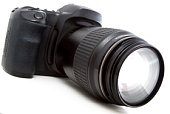
A new generation of Digital SLR cameras (DSLR) combine the best of both technologies. They use the SLR mirror system to allow the photographer to see exactly what the lens sees. Simply by replacing the film behind the shutter with a digital light image sensor instead, a DSLR camera is still able to capture images instantly. In this way, a DSLR camera combines the accuracy and speed of an SLR camera with the convenience of digital cameras.
As DSLR cameras are usually high-end machines intended for a professional market, they tend to be more expensive, but also incorporate other advanced features. An average DSLR camera usually includes auto focus options, live preview, electronic flash controls, the ability to swap specialized lenses, and electronic adjustment of the captured digital image, such as optimizing the contrast and color, red-eye correction, and monochrome options, among many others. DSLR cameras also generally have a larger digital image sensor, providing better quality images with a higher pixel resolution, lower noise, and a superior color range. While the price of DSLR cameras make them a financial investment, professional photographers and amateur enthusiasts will consider it well worth it.
Digital Single Lens Reflex Cameras
Also, those photographers you see use it for a reason. If you decide to buy a camera, there are important differences to note between digital single lens reflex cameras and ordinary digital cameras.
First of all, the SLR is known for its ability to accomodate many different types of lenses. Manufacturers have created up to forty different kinds of lenses that you can interchange when using digital SLR cameras. They all have different functions that often result in incredible photographs. Need to take a picture of an entire mountain? Get an ultra-wide-angle lens.
Want to focus on just one thing and ignore the background? Use a telephoto lens. Interested in taking pictures of tiny objects? Then the macro lens is the one for you. These are only a few well-known lenses among a wide range of useful ones. No other kind of camera has that feature.
Image quality is also a certainty when using digital single-lens reflex cameras. When put up against normal digital cameras, they will always produce a better picture when both have the same number of megapixels.
This is especially evident when you use digital single-lens reflex cameras with higher light sensitivities. They also have better performance overall, especially when you take into account their quicker autofocus, bigger memory buffers, shorter shutter delay and faster results when shooting continuously.
Digital SLR cameras are more functional. Even those some have better designs, triggers and buttons are easily accesible by the thumb and forefinger. Do not let the many buttons daunt you, for the important ones can be pressed easily, and often having to access a menu is not necessary.
Lastly, they can be upgraded to no end through the use of various accessories available in many camera shops worldwide. One can add more powerful flashes, more convenient power sources, wireless transmitters and even remote triggering devices that can take photography to an entirely different level.
However, digital SLRs do have their disadvantages. First of all, they are a lot bigger and heavier than normal point-and-shoot digital cameras. Because of the mirror system and pentaprism, the idea of a small singe-lens reflex camera at this time is inconceivable.
Also, accessories are normally carried around with it, which adds to the overall weight. They are also quite difficult to get the hang of when used by someone who is new to photography. Changing lenses constantly can also be an arduous task to some, aside from the camera having numerous buttons that can be very confusing. Lastly, they have generally higher prices that some people might not be able to afford.
Now that you know the advantages of disadvantages of digital SLR cameras, you can make your choice and see if they are the right camera for you. If you do pick the SLR, you will not regret it, for it is also a good way to sharpen your photography skills.
Both Ed Terran & Jonathan Popoola are contributors for EditorialToday. The above articles have been edited for relevancy and timeliness. All write-ups, reviews, tips and guides published by EditorialToday.com and its partners or affiliates are for informational purposes only. They should not be used for any legal or any other type of advice. We do not endorse any author, contributor, writer or article posted by our team.