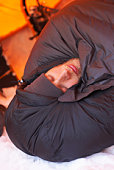
At home you can do a lot more to maintain your sleeping bag so that it can last a little bit longer. These tips cover how to wash, dry, store and repair your sleeping bag in the proper way.
Washing and Drying
- Keep your sleeping bags clean by washing it frequently but only when it is necessary. Washing too much can break down the properties of both down and synthetic fills.
- Always follow the manufacturer's instructions manual and use mild soap. You can hand wash or wash in the gentle cycle of a washing machine. If your sleeping bags are too large, bring them to a launderette and use a larger machine but never dry-clean a sleeping bag.
- When using the tumble dryer, use the lowest setting . Put a tennis ball into the machine to prevent the down from clumping. The ball will help dissipate the clumps.
- When wet, handle with extreme care. Do not dry on a clothesline. Find some place to that can support the weight of the bag so that the delicate baffles do not tear. Hanging it on the dryer is a common practice.
Storing
- Store your sleeping bag in a large cotton storage sack. Make sure the bag sit loosely in the sack. Avoid putting the bag in a stuff sack for long periods of storage because compressing it too much will reduce its loft.
- Don't store the sleeping bag in a plastic sack as the moisture will be trapped and hence provide a suitable breeding ground for mould, mildew and bacteria. Only store your bag when it is completely dry.
Repair
- Tears need to be repaired immediately especially the ones on the shell and lining.
- For temporary repairs use a duct tape or Gaffa tape. Instead on cutting the tape in a square, cut it in a circle so that it doesn't snag the fabric.
- Permanent repairs can be made with a nylon repair tape or patches that are sold in most outdoor stores.
- You can also ask a professional company that can do repair jobs for tears, separating seams and zip problems. There are quite a few of these companies around and they might even throw you a discount if you ask nicely.
On the Field
Remember that you should always keep your sleeping bag clean. Obviously washing your sleeping bag on the field would not be practical.
You might need to wash a little at times but if you use a down sleeping bag, drying would be a problem. Synthetics dry much faster and are easier to clean when you're camping. Down bags lose their insulating properties when wet while synthetics retains at least some of it.
Even so, it is better to always have a dry sleeping bag. Give your sleeping bag a daily shake to keep it fresh and ensure that the filling remain evenly distributed.
When airing a sleeping bag, never put it on bare ground, which is likely to be dirty or wet. If you can find a large, dry and clean rock, use it to dry your sleeping bag.
Keep the sleeping bag away from anything wet including your rain gear.
Down Sleeping Bag Reviews
One of the first questions you must consider when camping or backpacking is whether or not to take a tent.
For me I can say I always have and always will take a tent. Yes, it sometimes is a lot of weight, yes it sometimes is trouble to set up and yes it can be very expensive to buy a good one in the first place, but it is worth it.
Imagine if you will walking into camp and you are exhausted and want to only get some rest, some food and get clean. Well, there are all of these mosquitoes buzzing around your head and it is hot and you try to eat anyway, you try to nap but they are constantly flying around your head. Maybe the wind is blowing also, hey maybe it is raining, get my drift?
Well here I come and in a few minutes I set up my tent, climb in to get a snack and I am peacefully dozing while you are miserable in your light weight fantasy. (this is a poke at those who go "lightweight" at all costs)
Believe me all of these conditions happen and I have had them all happen to me. I even had a snake crawl right under my tent. Luckily he just kept on going, no harm no foul. If I did not have a tent perhaps he would have found a warm place to sleep in my bag!
Now that you are more apt to consider a tent, what kind do you want? In days of old there were only heavy, cumbersome, unstable tents to choose from. There are many types and price ranges. I will not go into all of that except to say I always take a free-standing tent. These can be moved away from the big rock in your back you did not see when you set it up and are very handy and well designed.Most of them have two entrances for the backpacker in mind as well as a rain fly, which as I mentioned is essential to stay dry.
Some in the lightweight crowd will say they do not need or will not carry all of this weight and trouble. These are the first people to convert as soon as it rains and they are just barely dry sleeping in their ill-conceived "bivy bag" in the mud while I am warm and dry reading my magazine and munching on chocolate. How are you doing out there Joe? Wet enough for you?
Now sometimes it is fun to take your chances and go light, the days when it is hot and there is absolutely no chance or rain; but these days almost never come. I think even on those days I would be the only one carrying a tent and the only one happy if it did rain or the wind came up.By my little tirade you can tell where I stand, can't you?
My stand is basically one for worry-free sleep. One of the few things you can control when you are backpacking or camping is the equipment at your disposal. I consider a tent to be absolutely essential and no one will ever convince me other wise. I just keep thinking of that snake in my sleeping bag.
Both Jonsky & Bill Kernodle are contributors for EditorialToday. The above articles have been edited for relevancy and timeliness. All write-ups, reviews, tips and guides published by EditorialToday.com and its partners or affiliates are for informational purposes only. They should not be used for any legal or any other type of advice. We do not endorse any author, contributor, writer or article posted by our team.
Jonsky has sinced written about articles on various topics from Home Management. Jonsky has a few more articles at hubpages including topics on down sleeping bags and. Jonsky's top article generates over 2400 views. Bookmark Jonsky to your Favourites.
Best Travel Car Seat You can drop the car at your last point in Italy. It may be Car Hire Lamezia Airport from where you can fly back to Canada or Germany or even Switzerland