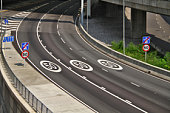
Drivers are aware of the consequences associated with exceeding the legal speed limit, such as the likelihood of an accident, danger of personal injury and the financial burden of getting that dreaded traffic citation. Until 1973, speed limits were imposed independently by each state, with no federal intervention. Nationally enforced speed limits originated in 1973 in response to an oil embargo against the U.S. which caused an oil shortage and resulted in a sharp rise in oil prices. Ensuring compliance by threatening to withhold federal funding from non complying states, Congress instituted a nationwide 55 mile per hour maximum speed limit.
Despite the speed limit’s original intention of reducing fuel consumption, government officials and the general public alike became conscious of its implications beyond fuel usage. The findings of numerous studies began to reveal the inherent safety implications of the imposed speed limit, most notably that the risk of death or serious injury in a car accident increased with speed.
Implementation of the national speed limit, however, was not met without resistance from affected American drivers. Common arguments declared that undue restrictions were being placed on citizens’ individual rights, and that the new law arbitrarily designated many Americans as law breaking citizens. Additionally, drivers argued that many highways had been designed to accommodate speeds greater than 55 miles per hour. As a result, in 1987 Congress passed an amendment to the law that allowed states to raise rural interstate speed limits to 65 miles per hour. It was not until 1995, with approval from President Bill Clinton, that legislation returned the authority of determining speed limits to the states and eradicated the national speed limit.
Though there is still a need to preserve oil as a natural resource, today’s speed limits are imposed with motorist safety being of utmost concern. Some dynamics which are considered in determining the speed limit for a given stretch of road are road conditions such as hills and surface curvature, access sites such as intersections and onramps, traffic volume, visibility distance, history of accidents and the findings from extensive field testing.
The fact that maintaining speeds at or below posted speed limits reduces the chance of death or injury in an accident bears repeating. Drivers should also consider factors besides the speed limit when determining a safe speed at which to drive, such as the external environment and traffic conditions. The presence of rain, snow and ice pose significant hazards to drivers and warrant a much lower speed than dry roads for adequate vehicle control. Likewise, extremely dense traffic typically requires slower speeds for one’s own safety and that of other motorists.
Driving The Speed Limit
There are some things you need to know avoid any kind of traffic problems and save yourself from frustration in the middle of the road.
When you are driving your vehicle you should try to avoid braking suddenly or starting abruptly. Studies indicate that when you brake gradually, start slowly, and avoid those sudden stops that you can increase your fuel consumption. Drive responsibly and with care to avoid these stops and starts.
Make sure that you observe the speed limit. Your gas mileage will decrease rapidly when you travel at speeds over 60 mph.
For every 5 mph that you drive over the 60 mph mark you are adding an extra 10 cents onto each gallon of gas that you purchase.
Keep in mind that you will be using at least 20 percent more gas when you are traveling at 70 mph than you would driving at 55 mph.
If there are other family members in your home that drive, particularly younger drivers, make sure that you keep them aware of the higher fuel costs that are associated with driving too fast and too much over the recommended speed limit that is posted.
If at all possible try to anticipate the driving conditions that you will be taking on your route. If you know the traffic is heavy on a certain road try to take an alternate route. This also applies to driving conditions that may cause you to tailgate or practice some other inefficient driving procedures.
The cleaner and smoother that your driving is the more fuel costs you will save. Take the time to plan your driving routes accordingly. You'll find that in the long run you're saving yourself frustration as well as money.
If at all possible you should try to avoid driving during peak rush hours. When the traffic is crawling along you'll be wasting gas and creating wear and tear on your car.
If you are heading home on a Friday night and know that your commute home is going to be one long slow crawl you may want to consider staying close to where you work and running some errands in the meantime. There is no need to start your commute home only to find that you are sitting in traffic with your car idling.
If you are approaching a hill try to accelerate before you reach the hill. This will help you to use up less gas while you are climbing the hill in your car.
Remember to accelerate in a safe manner or you won't be able to use this gas saving tip. You in no way want to put your life, or the lives of others, in any danger. If you drive at fast speeds using the wrong and often lower gears, you will reduce your fuel economy by as much as 40 percent.
If you are driving a standard vehicle make sure that you know how to properly operate the gears and know when to shift.This is one of the common mistakes that many drivers make. By paying more attention to your driving techniques you will find that you can reduce some of your fuel costs.
Try to avoid the habit of keeping your foot on the brake, even lightly, when you are driving. When you rest your foot on the brake you use more gas than you would otherwise and you also will wear out your brakes much sooner. If you find that you are keeping your foot on the brake without being aware of it you can try sticking a reminder note to yourself on the dashboard of your car. Start paying attention to your driving habits to see how important they are and to see how efficiently you drive.
So, now you know how to drive better, when to push the brakes and when and how to stop the car. And driving the car on the speed limits can save you not only your gas cost but can also help you avoids accidents that it can cause.
There are always other alternatives to avoid traffic problems and cut your fuel costs. This all depends on where and when you drives you car. Try to avoid rush hour as much as possible. These can both saves you time and fuel even the possibility of frustration.
Accelerating before reaching the hills and doing it safely can put you in a safe side. Right time to accelerate the gear with smooth driving can saves your life from possible dangers. So better be prepared when you are driving or riding way to the hilly roads.
Both Greg Chapman & Mitch Johnson are contributors for EditorialToday. The above articles have been edited for relevancy and timeliness. All write-ups, reviews, tips and guides published by EditorialToday.com and its partners or affiliates are for informational purposes only. They should not be used for any legal or any other type of advice. We do not endorse any author, contributor, writer or article posted by our team.
Greg Chapman has sinced written about articles on various topics from Brakes, Cars and Air Filters. About the Author: Greg Chapman, of Greg Chapman Motors, is a leading used car dealer Austin has depended on since 1959. For more information please visit. Greg Chapman's top article generates over 40500 views. Bookmark Greg Chapman to your Favourites.