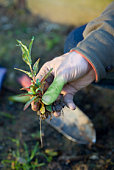
Herbs can be hardy plants. They are capable of doing well in poor soil, do not require very much fertilizer if any, often insect repellent, and do not need regular pruning. For these reasons, herbs can be great starter plants for new gardeners. The following are some basic herb gardening tips to get you started:
After making your choice of the herbs to grow, the next step is to ensure that you have the appropriate tools to properly care for your new plants. The two main tools you will need are a small shovel/spade and a spike or fork. If you are planting from cuttings, you can use the shovel to create a small hole. If you choose to start from seeds, you will only need to dig just below the surface. For seed planting, you will use a spike or fork for aeration of compact soil because herbs do better when they have good drainage.
If you do not have a pair of nice pruning shears then you should invest in a pair for your herb garden. Ordinary scissors are not an alternative for pruning shears. Occasionally, herbs need to be pruned and pruning shears are the only thing that can cut through thick stems.
A watering can is a good choice to irrigate your container garden; some have a single spout, and others a sort of sprinkler head over the nozzle. One of our basic herb gardening tips is that herbs require less water than most plants and root rot is a common result of over watering.
Watering cans may be suitable for herbs planted in pots and small areas. But for bigger gardens, an automatic water system that would save you time and money would prove indispensable. Although, it may require replacement every couple of years, a simple and inexpensive drip or soaker hose system can be easily established for the purpose.
One thing about hoses is that they can get damaged in cold weather. The frost will crack and break them. However, they can be spread across a large area in a short amount of time. Simply snake them between your plants and turn on the water. Just remember to take your hose inside when winter comes.
A wheelbarrow is a great tool to assist with your gardening. It can be helpful when you want to move plants that you started in containers to the garden. Another use is when you are extracting weeds. As you weed, you can simply throw them in the wheelbarrow and then remove them from your garden. This is especially helpful in reducing the chance of spreading the seeds of the weeds.
After planting, a 3-4 inch thick pile of mulch can be applied around the base of the plant. Mulch, which can be made from a combination of wood chips, bark, leaves, gravel, or even shredded newspapers, will not only minimize weeding later but also helps enhance soil fertility. It is just necessary, however, to leave about an inch in diameter of space around the base when applying mulch so as to avoid any excess buildup of moisture and heat that may cause unnecessary damage to the plant.
As you can see, these basic herb gardening tips are not difficult at all. Purchasing some good quality tools to use as well as some seeds is a fine beginning point. Then you'll need to find a spot of nice soil and start planting!
Cost Of Engine Replacement Repowering their engines using a high-powered Honda 20HP V-Twin small engine will extend the life of the vehicle while giving it the power available in newer models.Ben Anton, 2008