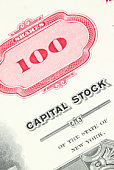
Though most certificates (even from a century ago) can be purchased for under $100, the sheer number of different certificates available (thousands), not to mention the expense of the rarer ones, precludes anyone from trying to collect them all.
For that reason, and due to personal preferences, people tend to give as gifts or to collect stock certificates by theme. These are a few of the more popular themes:
1.Industry - Railroads are popular industry themes. There were a great number of them and they literally created the infrastructure that allowed the United States to develop into a unified economic, cultural, political and societal entity Even within the Railroad category, however, most people focus on sub-segments such as the first electric traction railways ( trolleys) from a hundred years ago or all the small lines that consolidated to create a larger Railroad system. Other industry examples are aircraft, mining, oil, autos, retailers, banks, or any "industry" you define.
2.Geography - It's pretty neat to see the name of your state, county or even city on an old certificate. These collectors usually enjoy doing a little research and reading up on companies and locations they identify with or recognize. There are many hundreds of old certificates with town, county or state names in the company name, e.g., Maricopa Mica Mining Company (1890's) or Pennsylvania Salt Manufacturing Company (1927).
3.Vignette - "Vignette" is the collectors' term for the picture(s) on most certificates. They are usually quite detailed artwork created from etchings. A collector might choose, for example, animal vignettes (including American Eagles, foxes, dogs, horses, cattle, doves, cats and many others).
4.Family Relationship - If your last name is Morrison, you could have a beautiful, framed, authentic certificate from 1865 for "The Morrison Family Oil Company" hanging in your den. How about the Long Dock Company (1860's) or the Custer Channel Wing Corporation?
5.Time Period - Lovers of the Old West might like The Colt's Patent Fire Arms Manufacturing Company, The John B. Stetson Company or the Abercrombie and Fitch Company (they were actually important purveyors in the old days too).
There are many other possible themes (autographs, famous people, famous events, years...). And many certificates can fit in more than one theme, so there is no end to the satisfaction of creating a fine collection, but also the excitement of picking up on a new direction.
In any case, the collecting of these increasingly rare historical documents is a growing, rewarding pastime that is engrossing to pursue and fun to share with others (as you show them your 1865 Barnstable Bank and expound on commerce during the Civil War).
Old Stock Certificates Value
Dematerialization and controlled destruction. These are two terms a collector of stock certificates must now know. The effect of these two words is to create a situation for the collector where the supply of available certificates in the marketplace will be declining over time. There will be fewer certificates printed initially and any cancelled tickets will be destroyed more quickly.
Dematerialization itself is when paper stock certificates are no longer being issued. Paper stocks were initially important was because the investor wanted to have a piece of paper in their name, not the broker's. Today, the ability to record this information electronically and in a timely and secure manner creates efficiency and avoids the high cost to the issuing company of paper certificates.
This cost of issuing paper certificates continues to rise. To go through a broker, not only must the trading price of the stock be paid, but the broker's commission fee and the stock issuance fee (which can go as high as $100 per certificate) are also charged. You can see how the age of computers has definitely affected how stock certificates are issued. Certificates are decreasingly beautifully printed and engraved physical documents. They are often reduced to bytes and bits.
On the other hand, the computerization of stock ownership records eliminates the necessity of physically moving the certificates around. This computerization has reduced the opportunity for fraud (nefarious individuals would gain access to no longer valid certificates and present them as proof of ownership in the issuing company). In the past, when a stock or bond certificate was redeemed, cancelled or transferred, the piece of paper itself had to go through a transfer agent where the accounting transactions were made and the certificate itself was changed to indicate the action. After that, the SEC required that the certificates themselves by retained for a minimum of six years. This process created a huge amount of paper that had to be safeguarded.
There are a few instances of canceled certificates, scheduled to be destroyed, disappearing and then reappearing in the market place, represented as current or active. The practice of using small perforations has been a contributing factor in this situation since these perforations can be mistaken for the marks made by a notary or other seal. Additionally, the records of the transactions were often stored with the certificates themselves. In the case of theft, not only were the certificates taken, but the records which could have utilized to determine the status of the certificates, were also gone. When these cancelled certificates come into the marketplace, there is substantial opportunity for fraud.
What about collectors and their certificates? First of all, of this means that as time goes on, fewer certificates will not be coming into the marketplace because fewer are being issued and the remaining ones will be destroyed once they are no longer valid.
Secondly, the decreasing supply of new certificates for collecting will mean one of two things: either fewer people will collect them because they don't run across them as often, or, their rarity will increase their desirability as collectibles. Fortunately for those who love collecting antique stock certificates, the latter seems to be the case so far.
Dematerialization and controlled destruction are two important issues to be aware of and to watch as it affects the availability of new certificates to collect. Additional information on these issues and others surrounding securities and finance are published on the Securities and Exchange Commission's website, sec.gov.
Both Larry Crain & Cole Cawley are contributors for EditorialToday. The above articles have been edited for relevancy and timeliness. All write-ups, reviews, tips and guides published by EditorialToday.com and its partners or affiliates are for informational purposes only. They should not be used for any legal or any other type of advice. We do not endorse any author, contributor, writer or article posted by our team.
Larry Crain has sinced written about articles on various topics from Reiki Therapy, Stock and Stock. Larry Crain is a collector, author and dealer in Scripophily (the collecting of antique stock certificates). Images, values, more articles and research tools for old stock certificates can be found at. Larry Crain's top article generates over 2400 views. Bookmark Larry Crain to your Favourites.
Cole Cawley has sinced written about articles on various topics from . Collector-quality antique stock certificatesare available at http://. Cole Cawley's top article generates over 1300 views. Bookmark Cole Cawley to your Favourites.
20 Years Old Pregnant To discover how thousands are curing arthritis with simple and effective remedies, please visit our Cure Arthritis Naturally website to learn more about a guaranteed remedy report