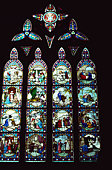
A window is an opening in an otherwise solid and opaque surface that<br/><br/>allows the passage of light and sometimes air
name="country-region"/>
name="place"/>
A window is an opening in an otherwise solid and opaque
surface that allows the passage of light and sometimes air. Windows are usually
glazed or covered in some other transparent or translucent material.
Etymology
The word Window originates from the Old Norse class=SpellE>vindauga, from vindr
"wind" and auga "eye." " class=SpellE>Vindauga" is still used in Icelandic, as well as some
Norwegian dialects to mean exactly the same thing: window. It is first recorded
in the early 13th century, and originally referred to an unglazed hole in a
roof.
Window replaced the Old English eag?yrl,
which literally means "eye-hole," and eagduru,
"eye-door". Most Germanic languages however adopted the Latin word class=SpellE>fenestra to describe a window with glass, such as Swedish class=SpellE>f'nster, or German fenster.
Notable exceptions to this, apart from English, are Danish and Norwegian, with
the English word window closely resembling the words vindue
and vindu respectively. This is probably due to the
Scandinavian influence on the English language by means of loanwords during the
Viking Age. In English the word fenester was used as
a parallel until the mid-1700s and fenestration is still used to describe the
arrangement of windows within a facade.
Definition and Types of Windows
A window is an opening in a wall that lets light and
possibly air into the room and allows occupants to see out. Primitive windows were
just holes. Later, they were covered with animal hide, cloth, or wood. Shutters
that could be opened and closed came next. Over time, windows were built that
both protected the inhabitants from the elements and transmitted light:
mullioned glass windows, which joined multiple small pieces of glass with
leading, paper windows, flattened pieces of translucent animal horn, and plates
of thinly sliced marble. Mullioned glass windows were the windows of choice
among European well-to-do, whereas paper windows were economical and widely
used in ancient China and w:st="on">Japan. In w:st="on">England, glass became common in the windows of
ordinary homes only in the early 17th century whereas windows made up of panes
of flattened animal horn[citation needed] were used as
early as the 14th century in Northern Britain.
Modern-style floor-to-ceiling windows became possible only after the industrial
glass making process was perfected. Evidence of glass window