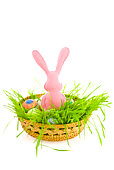
When Santa comes to town, the underlying lesson of doing something for someone else, with no expectations of anything in return, is understood. I mean, teaching our children the meaning of Christmas, on a level they can understand, is not always easy. But, most of us know the point we are trying to get across to them. But what about Easter? What are you teaching your children and why?
As a parent of young children I have had to recently address this very topic. Daddy, why does the Easter Bunny bring us candy? Hmmm... my initial answer, "I'm going to have to get back to you on this one." So let's take a look at that question. Yep, kids do keep you on your toes.
According to www.adherents.com, the most recent census shows that 82% of all U.S. citizens claim to be Christian. This percentage is even higher in many other major countries around the world. The heart of the Christian philosophy is the remembrance of Christ's resurrection and the promise of his everlasting presence. And, Easter is the time for remembering a completely selfless unspoken bond, between us all, strong enough to withstand an endurance of such pain, suffering and ultimately death, so that all could be forgiven.
But regardless of your religious preference, Easter can mean so many things. It's the beginning of Spring, a time to witness re-birth all around us from the grass below our feet to the birds that fly way above our heads. However, I believe there is one overwhelming gift that Easter brings us all. One concept that surrounds the Easter season above all others... that gift is HOPE.
Why hope? What is it? Arnold H. Glasow said that the most popular form of hope is expecting something for nothing. Perhaps, but that use of the word is somewhat slang. Hope is a gift given to each one of us. It's the possibility of triumph over transgression. It's the strength in knowing that even sometimes, under the most unfavorable odds, you can accomplish any dream. It's the serenity in knowing that at the end of any long dark tunnel is an opening to a whole new beginning. Come to think of it, it's what gets me out of bed in the morning.
Hope is such a powerful asset. We hope for ourselves, our families, our children, our friends and neighbors, just about everyone we meet. From my little girl watching an Olympic ice skater hoping that someday that will be her, to my neighbor hoping he gets the promotion he's been waiting for, hope is what makes all our dreams seem possible.
Easter signifies to the Christian community the resurrection of Christ and the origination of hope by every sense of the word. And Easter also marks the beginning of Spring when nature re-creates life giving all things a natural sense of hope's very existence. Easter is a time to reflect on the gift of hope that we all have been given. And think of the the Easter Bunny as an extension of this reflection on a level which our children can somewhat understand.
So back to our original question, "Daddy, why does the Easter Bunny bring me candy?" My answer, "Well, for now, just know that it is a very special time for all of us and the Easter Bunny just wants to make sure it truly is for you too and that you are not left out. Hope is a gift to all who choose to accept it. I hope you understand..."
Why The Easter Bunny
Easter is a big holiday, but few know all about its origin. We know that the Easter bunny comes on Easter and delivers eggs, but where did such a tradition come from? The following article will answer those questions and satisfy our personal curiosity, and give you the knowledge to answer children's many questions on the holiday. Here is some general information on Easter itself, the Easter Bunny, and the tradition of Easter eggs.
Easter
Easter, while gaining popularity as a secular holiday with the Easter Bunny and Easter eggs, is primarily an important Christian holiday. Easter is connected to the resurrection of Jesus Christ, which happened over a three day period according to Christian faith. The day Jesus was crucified is called Good Friday, and Easter Sunday itself takes place on the day he came back to life.
Unlike the other big Christian holiday Christmas, Easter does not have a fixed date. Instead, according to Wikipedia, it falls on or after the winter equinox, March 21. From there it is calculated following the cycle of the moon. Because of this volitality, sometimes different types of Christians celebrate Easter on difference days, depending on if they are Orthodox, Catholic, or something else.
The Easter Bunny
The legend of the Easter Bunny says a rabbit brings gifts to children the night before Easter Sunday. Specifically he brings colorful eggs and candy. As for where this idea originated, that is unknown. One theory, according to Wikipedia, is that the bunny originated with a spring children's game in the 1700's where a being named the Oschter Haws would leave colorful eggs for good children in a nest they had built out of garments. Supposedly, over the years this idea has evolved into the more famous egg hunt.
You may have noticed that Easter decorations overwhelmingly involve the bunny rabbit, with stuffed bunnies, bunny figurines, and tons of other bunny-related items. As for why a rabbit was chosen to represent Easter, this is because few animals symbolize the season of spring better. The bunny is known for its extraordinary fertility, and spring is a time of new life, as everything begins to bloom again. This is why the Easter Bunny seems so appropriate for this spring holiday.
The Easter Eggs
Fertility really is one of the main themes of spring, which is why eggs are also an icon of the Easter holiday. The new life theme is so important that people didn't stop with just eggs, many decorations also include little chicks and plush ducks too.
Though fertility seems to be something of a pagan idea, the egg tradition also has its roots in Christianity. The blood of Jesus was said to have spread over some eggs that were placed at the bottom of the cross he was on, where it painted the eggs red. So that's where the idea of painting the eggs came from. In fact, further in to the tradition, once the eggs have been painted red, Christians were supposed to tap them and say an Easter incantation praising Jesus' resurrection.
Obviously, the color choices for the eggs have evolved from the original red to multi-colored, and often pastel, but you can see where the tradition originally came from. In fact, the egg tapping itself has transformed into a different game where you tap until you find the hardest egg. In this game, the egg that survives the most taps without breaking wins.
So there you have it! The holiday of Easter has a long and interesting tradition that has evolved greatly overtime. Now that you are armed with the knowledge, you'll be able to answer any questions those curious children you know may have. This will also help you find the most appropriate stuffed bunnies and bunny figurines to mimic the Easter Bunny. Have a happy holiday!
Both Mark Bulleit & Carol Beard are contributors for EditorialToday. The above articles have been edited for relevancy and timeliness. All write-ups, reviews, tips and guides published by EditorialToday.com and its partners or affiliates are for informational purposes only. They should not be used for any legal or any other type of advice. We do not endorse any author, contributor, writer or article posted by our team.
Carol Beard has sinced written about articles on various topics from Bathroom Vanity, Family and Acai Berries. So feed your appetite for all that nice Easter decoration mentioned in the article! Find great stuffed bunnies, bunny figurines, plush chicks and many mo. Carol Beard's top article generates over 450000 views. Bookmark Carol Beard to your Favourites.
Design A Website Software So what is the answer to the question how long does it really take to design a website? Of course the answer has to be it depends! But if you are well prepared and your planned website consists of o...