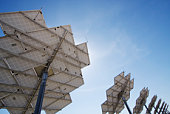
There are two main types of solar power, solar thermal and photovoltaic. Solar thermal uses the sun light's infrared energy to either heat a liquid or to warm a mass of material that will later on release its stored heat. Harnessing solar thermal energy involves building a house in such a way to collect the sun's heat during the day and radiate it into the home during the evening. However, in the summer time the house's construction uses mass to keep the sun's heat out of the home.
Solar photovoltaic energy converting sun light into electrical energy. The most commonly associated component are the photovoltaic panels or solar panels that you see mounted on roofs.
This article will be focusing on how photovoltaic solar power (solar panels) and systems work.
Why are solar photovoltaic panels always on the south (or north) side of the roof?
In order to get the maximum electrical output from photovoltaic panels they need to be oriented to solar south in the northern hemisphere and solar north in the southern hemisphere. Solar north and solar south are the same as magnetic or compass north or south. There is about a fifteen degree difference between them.
Most solar photovoltaic panels are set at home latitude plus fifteen degrees or home latitude minus fifteen degrees. Depending on if you want a summer or winter bias to the angle of the solar panels. In higher latitudinal areas it makes more sense to have the photovoltaic panels set on a winter bias, so that during the winter the solar panels still get enough sun light to produce electricity.
How does a photovoltaic cell produce electricity?
A solar panel consists of a collection of photovoltaic cells. Each photovoltaic cell is made up of silicon wafer. Silicon in its pure state is a poor electrical conductor. During the manufacturing process, an impurity is added to the silicon so that when the photons (light) strikes the wafer electrons are released and create electrical current.
The type of electrical current produced by a solar panel is a low voltage direct current, or DC, typically in the range of six to twenty four volts. Photovoltaic panels have a nominal output voltage of 12 volts and an effective operating voltage of 17 or more volts.
A solar panel's electrical output is affected by several factors. They are angle of the photovoltaic panels to the sun, time of day, time of the year and weather conditions. Solar photovoltaic panels produce more electricity during the middle of the day when the sun is directly overhead compared to the early morning and late evening when the sun light is striking the solar panel at a shallow angle.
Components of a residential solar power system
A residential solar power system consists of four components are: photovoltaic panels, charging controller, battery pack and an inverter. The photovoltaic panels convert sun light into electricity. The electricity is sent to the charging controller who keeps the battery pack fully charged, but not over charged. The battery pack sends the electricity to the inverter who converts the DC voltage to household AC at 120 volts and 60 hertz.
Photovoltaic panel
The output of a solar panel is stated in watts. The wattage is stated is typically for peak sun hours. Since the amount of sun light varies through the course of a day, to level out the variations the peak sun hours has been adopted by most manufactures to help installers and customer's compare different solar panel models.
Suppose a solar panel is rated for 100 watts and an average of six peak sun hours is available per day. Then the solar panel would produce 100 watts * 6 peak hours = 600 watt hours of electricity or 0.6 kilo watt hours (KWh).
Charging controller
Charging controller or charge regulator controls the charging of the battery pack. It continually monitors the battery pack's charge state. If the batteries are low, it will send electricity from the solar panels to the batteries. It also prevents over charging of the battery pack.
Don't allow someone to convince you that a charging controller is not really required. Directly connecting the photovoltaic panels to the battery pack can permanently damage the batteries and possibly cause them to explode.
Battery pack
The battery pack's purpose is to store electricity generated by the solar panels during the day and then at night or during extremely cloudy days provide electricity to the inverter.
The battery pack typically consists of lead acid batteries. Lead acid batteries are relatively inexpensive and readily available. There are many different types, sizes and capacities of batteries available. The most popular are gel cell and AGM deep cycle batteries because they are maintenance free and last a lot longer than wet cell lead acid batteries.
The most important thing to remember about the batteries is that the need to be deep cycle. Deep cycle batteries are designed to be discharged then recharged hundreds if not thousands of times. A deep cycle battery is designed to discharged to nearly empty, but not completely and then be slowly recharged over time. A common mistake for home owners is to think that they can use automotive batteries instead of deep cycle batteries. Car batteries are shallow cycle batteries. They are designed to discharge a lot of current quickly and then be immediately recharged.
Inverter
An inverter converts the DC electricity stored in the battery pack into household 120V AC. Almost everything in your home is powered by 120V electricity. Things like table lamps, freezer, lights, motors, dishwasher, and so on.
There are two main types of inverters sine wave and modified sine wave. The power company provides electricity as a sine wave. The electricity's charge value goes smoothly from positive 120V to 0V to negative 120V and then back up to 0V and finally up to positive 120V. Then the cycle begins all over again. The time it takes to go through the entire cycle is one second.
Modified sine wave is also known as a square wave. Here the electricity's charge value goes from positive 120V to negative -120 volts in effectively zero seconds.
Most household devices will function on a modified sine wave power. Light bulbs and motors will work, just not quite as efficiently as they would on sine wave electricity. However, there are some electronic devices that will not work on square wave electricity. It will be necessary to check with the manufacture to determine if the device will work on square wave electricity.
Now you have a basic understanding of solar power how it works to power your home. Now you have enough information about how solar power works to determine if it is a technology that you would want to invest in for your house.
Wind Power How It Works
Over the past years, most people never considered wind power as a serious source of generating energy and electricity, that too, for domestic purposes. In fact, wind was perceived as just another natural phenomenon with very limited usage in life. People generally reveled when the weather was pleasant, and tried to protect themselves when storms or blizzards attacked an area.
However, the situation grew more serious over time, as the oil crisis hit the world. The prices of oil rose rapidly, and the need for an alternative, less expensive source of energy was felt acutely. Such an energy source would indeed be required pretty soon. Now, wind power fitted the bill perfectly. In addition, the supply of wind power was plentiful as well. Thus, many experts tried to combine automobile alternators to radiator cooling fans. This was expected to produce 12 volts of DC current, and was quickly stored away on automotive storage 12 volt batteries. However stretching whatever little power that was produced to 120 volts of AC current, proved to be an unpractical task for most people. And thus, these trials on wind energy harnessing came to an end.
Business houses however, remained extremely active during this period. By the latter parts of 2007, wind power driven devices, like mini generators and turbines arrived in the markets, in large quantities too. Provided that enough quantities of wind power were available, these devices, coupled with utility grids, could substantially bring down the costs incurred on electricity by people. Experts decided to experiment a bit more with these equipments, in keeping with their mental make-ups. The wind turbines were used to try to generate electricity for one's home requirements. The potential benefits of such an experiment were huge.
It was not that all these attempts met with immediate success. Many people found the continuous roaring sound emitted by the wind turbines to be eminently disagreeable. Hence, they complained of mechanical nuisance to the local authorities, against their neighbors, demanding the turbines to be stopped. In such cases, the authorities were in fact bound to put a stop on the working of any win d turbine. The wind power generated by the turbines lacked in reliability as well. Often, the power could not even spin the turbine blades. The impact of these failed experiments was profound. People were saddled with debt, and attempted to resell their electrical equipments, including the turbines, related accessories, and the inverters that were meant to generate 12 volt usable AC current from the obtained DC power. However, not many were interested in buying these products then.
However, it was not all a story of failure and gloom. Several valuable lessons could be gleaned from these failed attempts to harness wind power. Some of these lessons were:
a) Never use wind turbines in congested city areas. The high rises and sky scrapers hamper the smooth flow of wind at these places.
b) Do not try to tap wind energy by using turbines in the urban regions. The noises affect the ecological balance of the area.
c) For best results, combine a solar electricity generator with the home wind power turbines. The former can work smoothly during daytime. As night arrives, the blades of the wind turbine can start to rotate
d) Erect home wind turbines at areas of high elevation and/or at remote places. The former would get smooth, unhampered flow of wind at such places.
e) Opt for home wind turbines if you cannot access utility power, and
f) Note the similarities between a small home wind turbine and a large scale energy firms. The structure, and hence, the complexities of the two are thus the same too, albeit in different degrees. The different components of the home turbines and larger wind energy firms, including the batteries (for smooth flow of power), the torque controller, the inverter (for conversion of DC output to 120 volt AC current) were all the same too.
Thus, you can learn from these lessons and set up your wind power system – all you need to do is refer to an instruction manual. The manual would help you know how to install the system, the ideal place to do so, as well as how to acquire different parts at an affordable price. Free availability of the batteries is also discussed in the manual. The wires of the wind power system, and the safety features related therein should also be given due importance in such a manual. So go ahead and read such a manual and get ready to benefit from wind power. This information would considerably ease the process of installation of the system and using it to your advantage.
Both Wilhelm Williams & Jim Martin are contributors for EditorialToday. The above articles have been edited for relevancy and timeliness. All write-ups, reviews, tips and guides published by EditorialToday.com and its partners or affiliates are for informational purposes only. They should not be used for any legal or any other type of advice. We do not endorse any author, contributor, writer or article posted by our team.
Wilhelm Williams has sinced written about articles on various topics from Home Management, Home Security and Fitness. Want more information on solar power installer? Try visiting http://www.homesolarpowerguide.com, a popular website that offers tips, adv. Wilhelm Williams's top article generates over 5400 views. Bookmark Wilhelm Williams to your Favourites.
Jim Martin has sinced written about articles on various topics from Home Management, Education and Gardening. Jim Martin is a researcher, inventor, home energy consultant and author of the #1 best-selling e-book, "Earth 4 Electricity- Renewable Energy Made Easy”. To Learn More about Jim MartinĀ“s Unique Step By Step Solar and Wind Power System Visit:. Jim Martin's top article generates over 12100 views. Bookmark Jim Martin to your Favourites.
A Brief History Of Music The mental effects will last much longer than the physical pleasure, but will pave the path for future enjoyments in bodily union