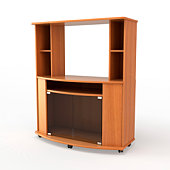
TV stands, audio racks, and entertainment centers have evolved with the changes in television technology. The days when televisions were considered a stand alone piece of furniture are long gone. Compared to the TV sets built just a few years ago, modern television sets are very different. The physical enclosure has changed, just as technological advances in television design have enhanced picture quality
Televisions became commercially available in the nineteen forties and the basic technology has revolved around the picture tube. The picture tube is a large cathode ray tube with a series of electron guns in rear of the tube. The electron guns shoot electrons at the front of the tube, which is coated with a fluorescent material. The fluorescent material causes the electrons to diffuse, the fluorescent material glows and through a series of signal modulations, a visible image can be seen.
TV sets today are much larger than older cathode ray tube sets. The difference is that the new high definition TV sets are no where near as deep. An older CRT television that measures twenty six inches diagonally may be as deep as twenty four inches. Compare that to a new high definition television, which might only seven or eight inches deep.
Early televisions were built into their own furniture cabinets mainly due to the number and size of the components that were needed. The sixties ushered in the age of the portable TV in part because of the introduction of the TV stand. Even though it was portable, the TV was still fairly heavy, requiring a platform of sort kind. A whole, new industry sprang up offering a variety of TV carts and stands.
In the past, American households with televisions usually had one set and being able to move the TV from living room to bedroom was a big deal. These early TV stands and carts were pretty basic, combining both a viewing platform and portability. The sets were not tied to a cable and many of us remember being able to wheel the television from room to room with ease.
As televisions shed the furniture look and became more of a stand alone video component, screen sizes grew and the TV became less portable. Another interesting development reduced the need for portability. Many American households had two or more TV sets. The living room or family room once again became a place to gather and watch TV. The age of the modern entertainment center had begun.
The television became an integral part of home entertainment systems as home audio moved to incorporate television into a single integrated entertainment system. Stereo receivers have ability to accept and process television audio signals from cable, satellite, and analog sources. Instead of having to rely on the speakers in the TV, we could channel the audio to our stereo speakers. It was not long before the introduction of surround sound technology would again change the way we listen to television.
The entertainment center and the TV stand have become the central focus for the modern electronics that have enhanced the television viewing experience. The need for cable and satellite control boxes meant that more space was needed. DVD players, surround sound processors, speakers and other components are now an integral part of TV viewing. These components need to be relatively near to the television monitor since a myriad of cables connections are still required to watch your favorite TV show.
The depth of the new high definition television sets is less than the old CRT televisions. Even a large fifty inch diameter set may be no more than six inches deep and can be hung on the wall in the same way one would hang a painting. Still, some sort of stand is needed for other components. That is where a good quality TV stand or entertainment center makes all the difference. The cathode ray tube technology will soon be a memory. Even if cords and cables are replaced by wireless technology, there will still be a need to neatly store and organize your video and audio components.
Regardless of the room decor, a TV stand or entertainment center will fit right in. The ultra modern look of some new televisions can be muted by a TV stand that is made in a more traditional style. Whether you chose a TV stand made of walnut, cherry, or other rich hardwood, you can maintain a traditional look while having ample space for all your components. From art deco to modern, there is a variety other styles that are sure to compliment any decor.
Wood Technology Tv Stands
Satellite TV uses a wireless system of transmitting radio signals to deliver its
television programming to the viewer's home or business. A radio signal can only travel in a straight line however. Enter the satellite. By placing an orbiting satellite at 37,000 km (22,300 miles) above the earth and having it match the earth's rotational speed (7,000 miles per hour) the satellite stays over the same spot above the earth. This is referred to as being in geosyncronous orbit. These orbits are sometimes also referred to as Clarke orbits in honor of Arthur C. Clarke who first came up with the idea in an article he wrote back in 1945 entitled "Extraterrestrial Relays" published in Wireless World Magazine. The orbiting satellite then retransmits the radio broadcast signal back down to earth to the receiving satellite dish (mini-dish)
located on your home or business. The signal then travels through coaxial cables from the dish into the receiver that is connected to your TV, where the signal is then descrambled into viewable programming for your family to enjoy.
Uplink Station
Satellite TV programming that you watch at home begins with a transmitting satellite dish or antenna located at what is known as an uplink station. The satellite dish located on your house is only 18" in diameter and is tiny compared to the huge satellite dishes used at uplink stations. These satellite dishes can be as large as 9 to 12 meters (30 to 40 feet) in diameter. The great size of these satellite dish transmitters allows for a much stronger radio signal and for better aiming of the signal at the orbiting satellite. The uplink dish is pointed toward a specific satellite and the uplinked signals are transmitted within a specific radio frequency range, so as to be received by
one of the transponders tuned to that frequency range aboard that satellite. The transponder 'retransmits' the signals back to Earth but at a different frequency band (to avoid interference with the uplink signal), typically in the C-band (4-8 GHz) or Ku-band (12-18 GHz) or both. The leg of the satellite signal path that transmits the signal down to the Earth station is known as the 'downlink'. Satellites can have up to 32 transponders for Ku-band and up to 24 for C-band only satellites. Typical transponders each have a bandwidth between 27 MHz and 50 MHz. Geostationary Kc-band satellites need to be spaced at least 1 degree apart to avoid signal interference. For C-band satellites the spacing needs to be at least 2 degrees.
Satellite Signal Technology
Original satellite broadcasts are converted into a high-quality, uncompressed digital stream containing a lot of data, and sends it at a speed of 270 megabits per second (Mbps) for each channel. All of this data must be compressed however or the satellite would not be able to receive the information. The system of compression used in the U.S. is the MPEG-2 compressed video format. This is similar to the system used to make DVDs. The provider could now reduce the 270-Mbps stream to about 5 or 10 Mbps, enabling them to transmit about 200 channels, instead of the 30 they could transmit before compression. These signals are scrambled so that only paid subscribers can receive them.
Mini-Dish Technology
Unlike their predesessors, today's satellite dishes are small, only 18" in diameter and are referred to as a 'mini-dish'. A typical satellite dish consists of two parts: the reflector and the feedhorn. The reflector is the concave dish-shaped part of the antenna. This is the part of the antenna that captures and focuses the satellite signal onto the feed horn. The feed horn is the part of the antenna that is mounted on an arm that sticks out from the relector dish. It takes the signal and feeds it through a cable to your satellite receiver (black box). Newer satellite dish designs feature multiple feed horns. This is
so the dish can pick up signals from several satellites and clearly focus the captured signal on one of the several feed horns.
Something called a feed horn has a feature known as a low noise block down converter (LNB). This provides for clear signal. The LNB does two things: It amplifies the signal received from the satellite provider, and filters out 'signal noise,' radio signals that do not carry the satellite provider's television programming.
Satellite Receiver
The satellite receiver is simply the black box that is connected to your television set. It receives the signal from your mini-dish and then de-scrambles the signal into viewable pictures for your family to watch. The receiver does three main things: It receives and de-scrambles the signal which contains the programming. It separates the programming into the individual channels you request by way of the channel selector button on either your TV or your remote control. It tracks your Pay Per View usage, and sends your billing information for this programming to your provider.
Today, there are several different kinds of receivers: standard receivers, DVR receivers and HD receivers for receiving high definition (HDTV) television programming. DVR (Digital Video Receiver) players allow the viewer to actually Pause and Replay live TV and to record up to 70
hours on the DISH Network DVR 311 or 322 players. The DISH Network DVR receiver is an advanced dual tuner, two TV output satellite receiver and integrated digital video recorder (DVR). The DISH Network DVR's were designed so that you never have to miss another favorite TV show again. No matter what your schedule; with the Dish Network DVR you can simply record your favorite shows with just the click of a button. DISH Network offers over 500 programming channels to choose from and all DISH Network satellite programming comes in 100% all-digital video and audio. So how does satellite TV work? In a word - perfectly.
Both Mike O'brien & Vishal Gupta are contributors for EditorialToday. The above articles have been edited for relevancy and timeliness. All write-ups, reviews, tips and guides published by EditorialToday.com and its partners or affiliates are for informational purposes only. They should not be used for any legal or any other type of advice. We do not endorse any author, contributor, writer or article posted by our team.
Mike O'brien has sinced written about articles on various topics from Culture, Information Technology and Gardening. Mitch Endick is a staff writer for the quality online store FineWebStores.com.Shop for. Mike O'brien's top article generates over 18100 views. Bookmark Mike O'brien to your Favourites.
Vishal Gupta has sinced written about articles on various topics from Small Business, Lose Weight and Small Business. Globcos provides Satellite Distribution, Satellite UP Link, Satellite Downlink, Teleport Services, Flyaway Services, SNG Services, Playout Services, Streaming and. Vishal Gupta's top article generates over 246000 views. Bookmark Vishal Gupta to your Favourites.
Best Email Web Hosting But the main point of all the debate is that nothing is predictable and as such it is imperative to conduct a proper research to get the best web hosting services.