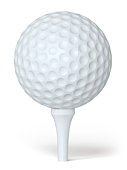
Is there a way to decide which is the best golf ball for your level of golf and your golf club swing speed? There is a way; you first need to comprehend the function of of each type of golf ball.
In this article I will not bore you with technical details about the the number of dimples on a golf ball, the materials that make up each layer of the ball, the diameter of a golf ball, or the weight. These details won't make any difference to you choosing the right golf ball, so I will stick to the most important specifications.
1-Piece Golf Balls
One-piece balls have no separate core and covering -they are just made from one solid material. You will find these balls on some driving ranges and they can be used by the beginner who doesn't want to loose expensive balls all the time. Although they don't have much distance, they are hard-wearing and low-cost.
The Two Piece Golf Ball
Two piece golf balls have a solid core enclosed in a cover which is made of a cut proof material, making them very durable. They are the ones that are used by most casual golfers because they give you maximum distance. This is because of their firm feel and low spin rate that causes them to roll further on the fairway. The drawback is that they are not as controllable as a softer ball.
The Three Piece Golf Ball
The 3-piece golf ball consists of a solid or liquid core encircled by a lining and enclosed by the outer cover. These are the preferred ball of many low handicappers that have the ability to take advantage of the higher spin rate and softer feel. These specifications make these balls more accurate for driving and they have more spin and control for the short game.
4-Piece Golf Balls
With golf ball technology advancing at a rapid rate, the latest improvement is the four-piece ball. They combine the characteristics of good distance, spin, and feel; they are generally marketed towards the more skilled golfer up to the PGA pro golfers. Each of the four layers helps the ball to perform to the maximum for distance, spin, and feel. You get great distance with the driver, plenty of spin with your middle irons, and enough control with your wedges and feel with your putter.
Low Spin Rated Golf Balls
The low spin rated golf balls don't carry as far of the tee but they will roll far after landing on the fairway. These balls are good for high handicap golfers that need to straighten out their golf shots; the low spin also applies to the side spin, so they are less liable to slice or hook.
Mid Spin Balls
The mid spin golf ball is the one suited for the majority of golfers. They offer a combination of distance and feel giving most golfers good distance and control. Sometimes the softness differs from brand to brand so you have to get used to the level of control.
High Spin Rated Golf Balls
The high spin balls produce maximum backspin that helps keep them airborne longer for maximum carry. When they land on the fairway, though, they won't run as far as the low or mid spin balls. Around the greens and on the greens you will get great control and feel.
Firm Feel Balls
Firm-feel balls will feel hard when you strike the ball with the club-face. The majority of distance golf balls are firm which is fine for distance but not good for feel around or on the greens. You will find that most high or mid handicap golfers will choose these balls because of the extra distance which they are willing to trade for the loss of control onto the green. Apart from the distance, these balls are the longest lasting and are difficult to scuff up or mark.
Mid-Feel Golf Balls
The most popular golf ball for the mid handicapper is the mid feel golf ball, as they combine the ability to produce good distance and control.
Soft-Feel Golf Balls
Soft feel golf balls are preferred by low handicappers and professional golfers. The best players can use their skill to work these balls any way they like. They are great for the short game where spin and the soft feel make them ideal. They are generally not suited to the casual golfer because they are not so good for distance and the soft cover scuffs easily.
Golf Ball Compression Ratings
The feel factor relates directly to the compression rate. Most golf balls are rated by the amount that they compress; a compression of 0 deforms by 0.2 inches or more and a compression of 200 does not compress at all. Soft feel balls are low compression golf balls that have a compression rating of around 50 to 70; whereas hard feel golf balls are high compression that are rated at around 100 or 110. Manufacturers can use different systems to rate their balls so they can differ from brand to brand.
It is generally recommended that slow swing speed golfers use golf balls with a compression rate of 80; golfers with an average swing speed should use compression 100; and Compression 110 is best for fast swing speed golfers.
The weather can also affect the different compressions of a golf ball so you should choose different compressions depending on the weather conditions. As balls don't compress as much when it is cold you should use low compression balls. Consequently, use higher compression golf balls when it is hotter.
You should also take into account the condition of the golf course; with sun scorched, hard fairways, you will need a soft feel golf ball that spins more so that you can control it when it hits the fairway or green. If the course is sodden, you will need a golf ball that carries further and that has less spin so that you have more possibility of greater distance.
Best Golf Ball For
Believe it or not, your golf ball selection can determine just that. Play your best golf by matching your ball to your ability, style of play, and equipment.
Perhaps you have more interest in buying a $300 driver or even a full set of clubs. However, keep in mind that a change as simple as buying a different ball (often a cheaper ball!) can dramatically improve your game. Follow these steps to evaluate golf ball comparisons and find the best ball for your game.
Ignore Marketing Ploys and Keeping Up With the Joneses
Do not buy a golf ball based on marketing information, price, or package labeling alone. Do not sell your game short by playing the XYZ ball because ABC does. Instead, use golf ball comparisons to locate a handful of balls that match your playing characteristics.
Understand The Basic Ball Types
You can easily rule out half of the golf ball choices by choosing whether you need a two piece or three piece ball (sometimes 4 piece). Each type has their own characteristics. Keep in mind that golf ball manufacturers can also vary the performance within each of these categories.
Two Piece Golf Balls
Two piece golf balls are made of a solid rubber core and a plastic covering. These balls are usually labeled distance balls. They can help higher handicapped players because they produce less spin. This results in less of a hook or slice from miss hits.
Three Piece Golf Balls
Three piece golf balls have a large solid core that is surrounded by various plastic-type materials. The outer cover is a soft rubber material. These golf balls produce more spin and have a softer feel. They are the ball of choice for most low handicapped players with consistent swings.
Dimple Patterns, Compression, and Spin Rate
There are more characteristics that determine the performance of a golf ball. Along with varying the thickness and hardness of the layers of a ball, engineers can work with many other variables to fine tune the performance. Skip the details, however, just match the characteristics to your swing and equipment.
Find a Few Good Matches and Test Them All
Once you have taken the time to find a few golf ball models that fit your playing style test them out. Try a few round with one type of ball, then switch to another. Just make sure to play enough to hit in several different situations.
Finally, the think again about how you determine which ball has the best feel. Ironically the concept has feel has a lot to do with sound. Today's equipment sounds different, and it seems all clubs are unique; this is especially true with drivers. This is why it is vital to play a couple of rounds using all of your clubs before accepting or rejecting any new ball.
Ultimately, matching golf ball characteristics to your specific swing characteristics will result in better performance, lower scores, and more enjoyment of the game.
Both Mick Euan Tait & Tim Heeter are contributors for EditorialToday. The above articles have been edited for relevancy and timeliness. All write-ups, reviews, tips and guides published by EditorialToday.com and its partners or affiliates are for informational purposes only. They should not be used for any legal or any other type of advice. We do not endorse any author, contributor, writer or article posted by our team.
Tim Heeter has sinced written about articles on various topics from Fat Loss, Golf Guide and Adwords. Tim Heeter is a golf coach and author of Golf Training Aids 365, a website helping golfers learn to take control of their golf game. Read more information about. Tim Heeter's top article generates over 3600 views. Bookmark Tim Heeter to your Favourites.
Commercial Kitchen Range Hood Or a simple hood meant to blend into the background can serve its purpose without drawing too much attention