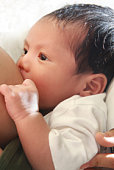
Babies have a sucking reflex that enables them to suck and swallow milk. It is possible for most mothers to nourish their infant (or infants in the case of twins and multiple births) by breastfeeding for the first six months, if not longer, without the supplement of infant formula milk or solid food.
In most situations human breast milk is the best source of nourishment for human infants, preventing disease, promoting health and reducing health care costs (exceptions include situations where the mother is taking certain drugs or is infected with tuberculosis or HIV).
Experts disagree about how long to breastfeed to gain the greatest benefit, and about the risks of using artificial formulas. In both developing and developed countries, artificial feeding is associated with more deaths from diarrhoea in infants.
The World Health Organization recommends a minimum of two years of breastfeeding and exclusive breastfeeding for the first six months of life. AAP recommends at least one year of breastfeeding and exclusive breastfeeding for the first six months of life. Exclusive breastfeeding for the first six months of life "provides continuing protection against diarrhea and respiratory tract infection" that is more common in babies fed formula.
The World Health Organization (WHO)and American Academy of Pediatrics (AAP)both stress the value of breastfeeding for mothers and children. While recognizing the superiority of breastfeeding, regulating authorities work to make artificial feeding safer when it is not used.
The primary function of mammary glands is to nurture young by producing breast milk. The production of milk is called lactation. (While the mammary glands that produce milk are present in the male, they normally remain undeveloped.)
The orb-like shape of breasts may help limit heat loss, as a fairly high temperature is required for the production of milk. Alternatively, one theory states that the shape of the human breast evolved in order to prevent infants from suffocating while feeding.
Since human infants do not have a protruding jaw like human evolutionary ancestors and other primates, the infants nose might be blocked by a flat female chest while feeding.[8] According to this theory, as the human jaw receded, the breasts became larger to compensate.
Milk production unrelated to pregnancy can also occur. This galactorrhea may be an adverse effect of some medicinal drugs (such as some antipsychotic medication), extreme physical stress or endocrine disorders. If it occurs in men it is called male lactation.
Newborn babies are often capable of lactation because they receive the hormones prolactin and oxytocin via the mother's bloodstream, filtered through the placenta. This neonatal liquid is known colloquially as witch's milk.
Not all the properties of breast milk are understood, but its nutrient content is relatively stable. Breast milk is made from the nutrients in the mother's bloodstream and bodily stores. Some studies estimate that a woman who breastfeeds her infant exclusively uses 400 to 600 extra calories a day in producing milk. The composition of breast milk depends on how long the baby nurses.
Research shows that the milk and energy content of breastmilk actually decreases after the first year. Breastmilk adapts to a toddler's developing system, providing exactly the right amount of nutrition at exactly the right time.
Breast Feeding And Drinking
10 Must Haves for Breast Feeding
1. Nipple Cream-Yes, nipples crack, get sores and it can be very nasty the first few weeks of breast feeding unless you are well prepared. Apply creams safe for the baby to swallow.
2. Warm Nourishing Food-Brings more and more flowing milk. Drink lots of warm drinks like warm chocolate, porridge also hot soup and anything else nutritious.
3. Breast Milk Pump-When you are overflowing with milk and need some relief a breast pump does the work for you
4. Breast Milk Storage Bags-For storing the extra milk you pump which you can use up to six months later when frozen
5. Nursing Pillow-Keeps your arms from getting tired and reduces pressure on your c-section
6. Nursing Cover-Breastfeed anywhere you want without having to hide especially in public or in front of guests.
7. Nursing Dresses-Anything comfortable that makes breastfeeding easy without having to strip is great.
8. Nursing Pads-It prevents uncomfortable and embarrassing situations when you start leaking milk especially in public.
9. Burping Skill- This is the hardest thing to do. Some have a talent of just holding the baby and it burps. Others have to learn the hard way when the milk start coming out from your baby's nose then you practice, practice, practice until the skill comes naturally.
10. Cabbage leaves-Cold clean cabbage leaves help reduce pain associated with engorged breasts when you are weaning. You just place them inside your bra to cover your breast.
Both Alisha Dhamani & Ray Rsa are contributors for EditorialToday. The above articles have been edited for relevancy and timeliness. All write-ups, reviews, tips and guides published by EditorialToday.com and its partners or affiliates are for informational purposes only. They should not be used for any legal or any other type of advice. We do not endorse any author, contributor, writer or article posted by our team.
Alisha Dhamani has sinced written about articles on various topics from Web Development, Careers and Job Hunting and Health. Information and reviews about breast enhancement, Breast pills and breast enlargement from top10herbal.comYour online source that offers tips and hints about natural breast enlargement.. Alisha Dhamani's top article generates over 18100 views. Bookmark Alisha Dhamani to your Favourites.
Ray Rsa has sinced written about articles on various topics from Real Estate, Breastfeeding and Health. Visit us at New Mommy Shoppe for more information.. Ray Rsa's top article generates over 12100 views. Bookmark Ray Rsa to your Favourites.