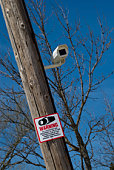
The modern homeowner has been aided considerably by advancing technology and nowhere is that more evident than in the field of home security. The tools that are now in the hands of the average homeowner were considered practical for only the wealthiest of people and large corporations only just a few years ago.
For instance, consider the subject of video surveillance. In times past the only solution offered was an analog closed circuit television system which was expensive and had serious drawbacks, including the fact that it was not possible to actually monitor events around your home from long distance as they happened. They had to be saved to some type of recording device, most often video tape, and then viewed later at once to provide any useful information.
But with the advent of the computer age, networking, and the internet, great improvements have been made to the advantage of the average homeowner. Chief among these is the rise of digital recording devices instead of analog equipment. By capturing the video in digital format, it could then be broadcast to another distant location and even viewed live as it happens. It also improved the captured images considerably, and made for much better image quality.
Because of the internet, we now have the ability to log onto the web and view video feeds from cameras at our home live as they are recording. By combining this technology with the right software product we can even view more than one camera's output at the same time. So if you have for instance 5 cameras around your home, you can watch them on your monitor screen whenever you wish to keep an eye on what is happening even though you are many miles away.
Having such a digital home security camera system is not all that expensive either, and with the rising number of people becoming familiar with setting up their own wireless computer systems, it is also becoming a home security measure that many can install themselves.
So if you have the need to keep up with what is happening at home when you are away for any reason, why not consider getting a digital camera system for your own peace of mind?
Home Security Video Surveillance
1. Determine where the cameras will be placed to provide maximum coverage.
You need to know where the cameras will be placed in order for them to meet the needs and requirements of your family. This will enable you to purchase cameras that will have features designed to work best in certain situations. Not all cameras work exactly the same way. Some will work fine in tight spaces while others will not perform as well.
2. Consider installing 'nanny cams' inside your home
Small cameras such as the "nanny cam" can be used to secretly monitor any help you have in your home, such as a cleaning lady, an installer, or a caregiver for your children. With all the horror stories of incidences involving children when in someone else's care, it is no surprise that concerned parents are resorting to this method of surveillance.
When people know that there is a video camera in the room, they act differently. They are more cautious of their actions.
Nanny cams work best when they are well hidden so that no one knows they are being monitored. When selecting the location of where to have the camera(s) installed, make sure that you maximize the field of vision for each camera. It is pretty useless to have a camera installed that only covers a small area of the room, which is the least frequently used space in the room.
3. Determine the number of cameras
You will also need to know the number of cameras needed to accommodate your home and your yard. The system you purchase will depend on the number of cameras required for your needs.
Leave room for future upgrades and adding additional surveillance cameras to the system. The last thing you want to do is buy a system and have it installed and then a month later realize that you need one more camera, but they system cannot accommodate any more video cameras.
4. Would you like digital or analog video?
What is the difference? Analog video is an older technology? well dates back to the original TVs. Analog video tends to produce a grainier image. Analog black and white video cameras tend to produce a better image in low light situations, such as at dusk.
Digital video surveillance cameras give you a much clearer video image; however, in low light instances, they do not perform as well. With a digital video cameras the video can be stored on a computer hard disk in a very compressed format that will give you many hours of recording time before the system 'loops' and over writes the oldest video images.
Another option is a hybrid video surveillance, where the analog video cameras are connected to an analog to digital converter and then the video is stored digitally on your computer.
Both Jim Johnson & Wilhelm Williams are contributors for EditorialToday. The above articles have been edited for relevancy and timeliness. All write-ups, reviews, tips and guides published by EditorialToday.com and its partners or affiliates are for informational purposes only. They should not be used for any legal or any other type of advice. We do not endorse any author, contributor, writer or article posted by our team.
Wilhelm Williams has sinced written about articles on various topics from Home Management, Home Security and Fitness. To continue reading 8 Things You Need to Know about Home Security Surveillance at. Wilhelm Williams's top article generates over 5400 views. Bookmark Wilhelm Williams to your Favourites.