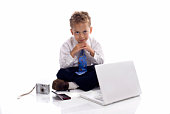
In the past, parents relied on chalk boards and pens and paper to teach their children the alphabet. With the help of electronic gadgets, a parent can now teach a young child so much more. Children have a variety of things that they can study on their own and only require the help of a parent when they need a machine turned on. These electronic gadgets have helped children prepare for school and many are ready to learn more when school is in session for the first time.
Some of the electronic gadgets that help children learn will operate through a video game system in the home. The teacher in these videos is usually an animated character that is sure to fascinate children and keep their attention trained on their studies for an hour or two. A child can be guided by a digital character on the television screen and that character will be waiting when a child gets up from a nap.
Some of the digital tools that parents can use to train a child are push button, hand held games that a child can use in the back seat of a car. These electronic gadgets are perfect for long road trips because a child is entertained with the programming on these devices. The electronic cards can be quickly changed out and another amusement can be started without any inconvenience at all.
Some electronic gadgets teach children to learn by using multiple choice test questions. This is the method that is most often used in schools and will serve to familiarize the child to testing in schools. By the time a child enters school for the first time they are better adjusted to a learning environment and view school as a fun place where exciting things are learned.
Some children learn to tell time with the help of an electronic clock. Many of these clocks are placed in plastics that are formed like characters like rabbits, turtles, and bears. These electronic gadgets teach kids to be responsible and to be punctual. A child also gets a chance to practice using electronic devices because they need to set the time that they wake up each morning.
Some kids like electronic gadgets because they are amusing. There are many forms of entertainment that use some sort of electronic device to operate them. Children can play outside and learn how to steer wireless automobiles that require a electronic chip to make them do tricks. While a child might learn the basics of driving an auto while using these electronic devices, they are also learning some quick responses because these vehicles do not always respond as someone might expect them too.
How To Help Children Learn
I remember the listening center I set up in my elementary school classroom as if it was yesterday. It was my first year of teaching, and I was so proud of that blue denim beanbag chair and cassette tape listening station that I had put together to introduce Spanish to my second graders. I had decided not to subject the little seven year olds to me singing acappella on the tapes I made at home, but I did incorporate some rhythmic beat to make the learning easier. I chanted the vocabulary word in English first then in Spanish and repeated the pair again, leaving time for the student to repeat the words out loud.
It worked! The little darlings were begging me to make more and more tapes each weekend, thinking I had no other life outside of being their teacher. (For those of you who are teachers you can so relate to that feeling!) And so it was, way back in the early 1980s, I was carrying on the tradition of what generations of parents and teachers had been doing which was to introduce new concepts to kids with rhythm and song.
Why does this technique work so well that even as adults we recall a cute little tune our French teacher taught us to learn the colors in French or that silly little chant our Science teacher rapped off to us about the Solar System so that we never forgot the order of the planets as long as we could recite our little rap out loud? There are many studies, some recent and some from years back, that explain to us how music works so well in the learning process.
As adults, we intuitively realize that students who have had the opportunity to study music tend to do better in school and in life, and over the years there has been quite a lot of research to support those feelings. It has been proven that children who study music perform better on tests. There have been many studies conducted where the conclusions point to kids participating in music programs show enhanced academic performance and better social skills.
It is even more astounding to note that a study conducted by the College Entrance Examination Board reports students with experience in music performance or courses that involved music scored more than fifty points higher on the verbal section of the SAT and more than forty points higher on the math section. As a parent and teacher that means a lot to me and my take on the arts in the education of my children.
Music engages children and allows them to learn concepts that sometimes are difficult without the beat or without the rhythm of a song. It allows children to remember important facts, whether they are in history, science, math or language arts. Imagine the feeling of success a child experiences once he has mastered his ABCs thanks to that little song placed to the melody of Twinkle, Twinkle Little Star. You have seen the delight on many faces of toddlers and preschoolers who master that twenty-six letter song!
Music helps many children build a level of confidence they might never have experienced had it not been for music. Children gain nourishment from music in their classrooms, in their homes, in their daily routines. Sometimes that child who feels no success in the academic side of school finally is introduced to music with that one special teacher and the rest is history (no pun intended!). Drop outs may become drop ins thanks to a little rap, a simple play of jazz or a classic tune played during art class for inspiration.
Exposing children to other cultures, other people, and other lands far from theirs come many times through music. What a lovely way to hear what the new student in school used to listen to daily by appreciating and playing the music from his country during his first week in class. Imagine the impact that teacher makes on the success of this new student by embracing the culture of this new student, inviting her to bring in a CD from home or a song book from her childhood. The encouragement it provides her as a new member of this society along with the world experience it allows all of the members of the class to have are things no text book could ever provide with such feeling, such emotion.
Music is the universal language of our world. Whether you speak English, Spanish, French, Hindu, Mandarin, Farsi, or any of the other thousands of languages in our world, you will always be connected to your neighbor, your co-worker, your new friend by music. And it is that music that should continue to be a large part of the learning you expose your child to and insist that his school continue to incorporate in order to bring the learning to life and make the learning fun.
Abs With Exercise Ball DONT grab your nape and DONT apply force in your hands to help you raise yourself up. This is what causes neck strain in crunches improperly practiced. Exhale as you come up. Inhale as you release