Because you should not wear your contact lenses when experiencing these problems, you should have an up-to-date pair of glasses for these times. With well-fitting contact lenses, you should be able to remove your lenses and see well with your glasses, essentially immediately.
Blurred vision, lasting for hours, upon removal of the contacts is usually a sign of poorly fitting contact lenses. If your vision is blurred, with your glasses, when lenses are removed, notify your fitter.
You should examine your contact lenses for any defects. In the case of a torn soft lens or a cracked gas permeable lens, your eye should feel immediately relieved once you remove the lens. If soap or cleaning solution gets in your contact lens case and, in turn, on your lenses, irrigate your eyes with your rinsing solution or tap water.
This can be extremely painful. Then, either discard the lenses or rinse them off multiple times in the storage solution to rid the lenses of the soap.
When the irritation is from something blowing into the eye, remove the lens and look for a foreign body. The foreign body may be removed with a cotton-tipped applicator or a rolled-up piece of facial tissue. Once removed, your eye should feel immediately relieved of the discomfort.
If eyedrops are prescribed for an infection, you should use these eyedrops, usually with the contacts out of your eyes. Ask your doctor whether you should remove your lenses when instilling drops. You should not wear contacts when your eyes are red or irritated.
To instill eyedrops, hold your head back and squeeze one drop out of the bottle. Do not touch your lashes or eyelids with the dropper. Close your eye for about 30 seconds after instilling the eyedrop, and do not rub your eye.
Treatment of contact-lens problems ranges from not wearing your contact lenses for a short time to intensive antibiotic treatment of infections. You may have to wear your glasses for a variable period of time. After the condition is cleared, you might have to be refit with new or different lenses.
If only one eye is affected, you may be advised to discontinue the contact lens in the other eye, as some infections may spread into the uninvolved eye. If the lens is worn out or torn, it must be replaced. With frequent replacement lens wear, you usually have extra lenses at home and can easily replace the lens yourself.
If a solution incompatibility is suspected, solutions and the care regimen are evaluated, and you may be required to change solutions.
If the lens is not fitting well, wear of that lens is discontinued. It may be necessary to refit you with new lenses of the same or different material, which may be better tolerated or may provide better vision.
With infections, antibiotic eyedrops are used. Pills are rarely used because eyedrops are usually more effective.
Your eye doctor chooses the eyedrop that is most effective for the particular infection. Eyedrops may need to be used every hour. You might have to be seen every day with more serious infections.
With corneal infections, a culture of the infection may be taken to help determine the best antibiotic eyedrop.
On rare occasions, surgical management of the infection may be necessary. Ultimately, if more conservative treatment is not successful, antibiotic injections into the eye or even a corneal transplant may be necessary.
Special Effects Contact Lens
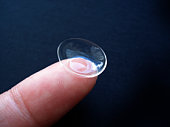
Soft contact lenses: first introduced over 20 years ago, are made from flexible, water-absorbent plastics. These contacts are anywhere from 30 to 80 percent water. Some soft lenses are designed to be thrown away daily, weekly, or every other week depending on your eye care professional's instructions.
Disposable contact lens options have increased dramatically. Even one day disposable contact lenses are now available. Other types of lenses can be used for up to a year. Many people enjoy the comfort of soft contact lenses. They're easy to insert and fit comfortably and securely.
Another popular trend is the colored contact lens option. Recent developments have allowed users to change their eye color simply by changing their contact lens.
Although the standard "hard lens" introduced in the 1950's are still around, technology and materials developed have made these lenses virtually obsolete. Fewer than 0.5 percent of lens wearers own them. Two types of contacts are fitted today - soft and rigid gas permeable, also known as RGP's. RGP lenses are made of special, firmer plastics that are suited for the passage of oxygen and other gases. These lenses are very durable and typically last longer than soft lenses. RGP lenses offer crisp vision and are often preferred by people with high degrees of astigmatism. While they make take a little longer to get used to, regular wearers find them to be comfortable and the visual acuity outstanding.
DISPOSABLE CONTACTS - THE ULTIMATE WAY TO SEE
Disposable contact lenses are usually prescribed in multi-packs, providing several weeks supply at a time. The most common and popular brands are Acuvue , Focus and Biomedics.
A growing number of people now use these products, which can be worn for either a single day, or up to seven, depending on the wearing schedule prescribed by your eye care professional. Even bifocal wearers can now get discount prices when ordering.
Six per box is the average number per supplier. They are usually used for anywhere from 1 to 2 weeks on a daily wear basis and approximately 1 week if used as extended wear. Replacing frequently usually means better eye health. Other obvious advantages are having spare ones immediately available should one get torn or lost.
Be sure you wear your back up eyeglasses at least once a week to give your eyes and cornea a chance to reoxygenate. Symptoms of overwear include burning eyes, dryness, blurred vision and seeing halos around lights. This can lead to serious corneal problems and infections. Consult your eye doctor regularly for eye examinations and follow up care.
Frequent and Planned Replacement contact lenses are replaced on a planned schedule, most often every two weeks, monthly or quarterly. These items usually come 4 to 6 per box. Eye care professionals may recommend enzyming them if they are used longer than one month. A popular brand is the Focus Monthly from Ciba Vision.
COLORED CONTACTS - THE LATEST TREND
Colored contact lenses are a growing trend among contact lens wearers, they change the natural eye appearance to a different color. The leading manufacturers continue to increase the number of options available to consumers.
In addition, colored contact lenses are also now available in disposable form. The originator of the changing eyes fad, Wessley Jessen now make a two week disposable, called Freshlook. It is available in Blue, Green, Violet or Hazel. The latest addition to the collection is the Freshlook Colorblends available in Blue, Brown, Green or Gray. Some users have reported that these have a more natural appearance when used on darker eyes.
BIFOCAL CONTACT LENS - BOOMERS BATTLING BIFOCALS
A bifocal contact lens may be an option for you if you are on the far side of 40. Should you find that reading the phone book or newspaper is suddenly a chore, welcome to middle age, and presbyopia.
Presbyopia, the farsightedness that is inevitable with aging, is caused by the gradual hardening of the lens of the eye. It becomes less able to change shape, preventing us from focusing on close objects. Most people become aware of deteriorating lose vision in their mid-40s.
Many people turn to inexpensive reading glasses, but it's important to have regular eye exams. Prescription lenses and bifocals allow a close-up correction giving the best possible vision for both close and far. If you are bothered by the telltale line that marks the bifocal, you may opt for bifocal contact lens.
Should your doctor decide that these are not an option, another increasingly popular alternative is called monovision. You wear a contact with a close-up correction in one eye and if necessary, a contact for distance correction in the other. Your brain gradually learns to adapt, and you see reasonably well thought out your range of vision.
The close-up contact generally goes in the non-dominant eye. Most people adapt to this type of len correction in a week or 10 days even if they have never worn contacts before. Even people with astigmatism can be successful with monovision, often using rigid gas-permeable contacts instead of soft contacts for more reliable correction.
While true bifocal contact lenses are available, most people adapt to them less successfully than to monovision Bifocal contacts are difficult to fit, and they don't work for everyone. However, the latest disposable bifocal contact lenses from Acuvue have been very successful.
Both Alisha Dhamani & Dr. Dhavid Cooper are contributors for EditorialToday. The above articles have been edited for relevancy and timeliness. All write-ups, reviews, tips and guides published by EditorialToday.com and its partners or affiliates are for informational purposes only. They should not be used for any legal or any other type of advice. We do not endorse any author, contributor, writer or article posted by our team.
Alisha Dhamani has sinced written about articles on various topics from Web Development, Careers and Job Hunting and Health. Jigfo.com is a source of global information. Learn and share knowledge with thousands. http://www.jigfo.com. Alisha Dhamani's top article generates over 18100 views. Bookmark Alisha Dhamani to your Favourites.
Dr. Dhavid Cooper has sinced written about articles on various topics from Eyewear, Health. If you would like to publish this information on your website, include the following information with a direct link to http://www.framesdirect.com. Dr. Dhavid Cooper and Dr. Guy Hodgson are the founders of. Dr. Dhavid Cooper's top article generates over 1000 views. Bookmark Dr. Dhavid Cooper to your Favourites.
Cordless Phones With Talking Caller Id The base included a charging cradle, was generally a form of trickle charger, on which the handset rested when not in use.