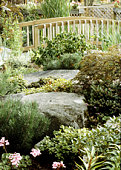
Transplanting an entire garden can seem like a monstrous undertaking. When transplanting a garden, it is necessary to ensure that the plants make it from their original hole to their new hole in a reasonable amount of time. Most people begin a project like transplanting a garden in late spring or early summer, when the weather is fairly consistent but not too overwhelmingly hot.
Hearty plants and flowers can go as long as forty eight hours when transplanting a garden before returning to the earth, provided that there is ample soil left on the roots. Whenever you begin transplanting a garden, the more soil that can remain on the roots the better chance of survival the plant or flower will have post transplanting.
The trick to transplanting a garden is keeping the transplanted plants and flowers well hydrated during the entire process. Transplanting requires the hole, which you insert the plant, followed by ample soil and water. You don't want to trap air in the hole with the plant when transplanting a garden. The air will negate your efforts and the plant may suffer damage or die.
As you add soil and water, be sure to press the wet soil deep around the roots while transplanting the garden. This will help eliminate air pockets and ground the roots in deep.
Transplanting a garden one plant or flower at a time can take a very long time. If you dig up approximately 30% of the plants to be transplanted to the new garden and transplant those first, you will be able to make faster progress in transplanting the garden while not placing too many plants in jeopardy. Plants waiting to be transplanted can be placed in plastic trash bags for twenty four to forty eight hours and survive the transplantation process.
As you complete transplanting 30% of your garden, stop and give the transplanted plants a thorough soaking before moving on to the remaining plants. Do this each time, as you are trying to give them ample water to create a suction effect with any air pockets that may have remained while you were transplanting the garden.
Sensitive plants may not survive being transplanted form one garden to another. If you intend to keep the original garden at all intake, try to transplant only those hardy plants that are likely to survive the transplanting of the garden. If the sensitive plants must be transplanted, try to do them first and keep them out of the ground for as little time as humanly possible. The drying out of the roots is what kills most plants when transplanting a garden.
Things In A Garden
But we will now suppose that it is possible to really choose just the right site for the garden. What shall be chosen? The greatest determining factor is the sun. No one would have a north corner, unless it were absolutely forced upon him; because, while north corners do for ferns, certain wild flowers, and begonias, they are of little use as spots for a general garden.
If possible, choose the ideal spot a southern exposure. Here the sun lies warm all day long. When the garden is thus located the rows of vegetables and flowers should run north and south. Thus placed, the plants receive the sun's rays all the morning on the eastern side, and all the afternoon on the western side. One ought not to have any lopsided plants with such an arrangement.
Suppose the garden faces southeast. In this case the western sun is out of the problem. In order to get the best distribution of sunlight run the rows northwest and southeast.
The idea is to get the most sunlight as evenly distributed as possible for the longest period of time. From the lopsided growth of window plants it is easy enough to see the effect on plants of poorly distributed light. So if you use a little diagram remembering that you wish the sun to shine part of the day on one side of the plants and part on the other, you can juggle out any situation. The southern exposure gives the ideal case because the sun gives half time nearly to each side. A northern exposure may mean an almost entire cut-off from sunlight; while northeastern and southwestern places always get uneven distribution of sun's rays, no matter how carefully this is planned.
The garden, if possible, should be planned out on paper. The plan is a great help when the real planting time comes. It saves time and unnecessary buying of seed.
New garden spots are likely to be found in two conditions: they are covered either with turf or with rubbish. In large garden areas the ground is ploughed and the sod turned under; but in small gardens remove the sod. How to take off the sod in the best manner is the next question. Stake and line off the garden spot. The line gives an accurate and straight course to follow. Cut the edges with the spade all along the line. If the area is a small one, say four feet by eighteen or twenty, this is an easy matter. Such a narrow strip may be marked off like a checkerboard, the sod cut through with the spade, and easily removed. This could be done in two long strips cut lengthwise of the strip. When the turf is cut through, roll it right up like a roll of carpet.
But suppose the garden plot is large. Then divide this up into strips a foot wide and take off the sod as before. What shall be done with the sod? Do not throw it away for it is full of richness, although not quite in available form. So pack the sod grass side down one square on another. Leave it to rot and to weather. When rotted it makes a fine fertilizer. Such a pile of rotting vegetable matter is called a compost pile. All through the summer add any old green vegetable matter to this. In the fall put the autumn leaves on. A fine lot of goodness is being fixed for another season.
Even when the garden is large enough to plough, I would pick out the largest pieces of sod rather than have them turned under. Go over the ploughed space, pick out the pieces of sod, shake them well and pack them up in a compost heap.
Mere spading of the ground is not sufficient. The soil is still left in lumps. Always as one spades one should break up the big lumps. But even so the ground is in no shape for planting. Ground must be very fine indeed to plant in, because seeds can get very close indeed to fine particles of soil. But the large lumps leave large spaces which no tiny root hair can penetrate. A seed is left stranded in a perfect waste when planted in chunks of soil. A baby surrounded with great pieces of beefsteak would starve. A seed among large lumps of soil is in a similar situation. The spade never can do this work of pulverizing soil. But the rake can. That's the value of the rake. It is a great lump breaker, but will not do for large lumps. If the soil still has large lumps in it take the hoe.
Many people handle the hoe awkwardly. The chief work of this implement is to rid the soil of weeds and stir up the top surface. It is used in summer to form that mulch of dust so valuable in retaining moisture in the soil. I often see people as if they were going to chop into atoms everything around. Hoeing should never be such vigorous exercise as that. Spading is vigorous, hard work, but not hoeing and raking.
After lumps are broken use the rake to make the bed fine and smooth. Now the great piece of work is done.
Both Lanny Hintz & Kim And Charles Petty are contributors for EditorialToday. The above articles have been edited for relevancy and timeliness. All write-ups, reviews, tips and guides published by EditorialToday.com and its partners or affiliates are for informational purposes only. They should not be used for any legal or any other type of advice. We do not endorse any author, contributor, writer or article posted by our team.
Kim And Charles Petty has sinced written about articles on various topics from Recreation and Sports, Internet Marketing and E Books. Kim and Charles Petty,experts in Real Estate Market. For FREE Special Report and CD and to set up strategy session on how you can make Six or Seven Figures A Year Buying and Selling Propertiesacross the USA & abroad go to. Kim And Charles Petty's top article generates over 40500 views. Bookmark Kim And Charles Petty to your Favourites.
Breast Enlargement Birth Control Pills There are many reasons for growing popularity of natural pills. Natural products do not cause any side effects and never disturb normal physiological process in human body