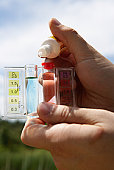
The developing country is getting closer to improving the quality of their water that is available to its population. Coverage of the problem has increased from one percent in 1981 to 48 percent in 2007 which means that more people are becoming aware of the importance of water testing. This achievement has made it possible for the country to collect the Millennium Development Goal in hygiene ahead of schedule.
It has become increasingly important for countries such as India to engage in regular water testing as 1.8 million children die every year around the world because of bad quality water. This equates to 4,900 deaths every day. With regular water testing however, problems can be identified and fixed and the number of deaths every year can be reduced. Nearly 20 percent of the world's population does not have easy access to drinking water and 40 percent lack sanitation facilities. It is well known the majority of these people are in developing countries.
Today, 90 percent of the rural population has access to safe drinking water. However, millions of people still have no access, especially to sanitation services which is important for environmental cleanliness and proper health and hygiene, particularly women and children. In fact, 2.4 billion people live in conditions lacking adequate sanitation. In the absence of it, many people die due to various water and sanitation - related diseases. Again, areas with bad water can easily be identified with regular water testing. Action needs to be taken quickly about these water problems because more than 800 million people, which is 15 percent of the world's population is malnourished which is partly due to insufficient water for crops.
Not having access to clean water and sanitation facilities threatened life, destroys opportunity and undermines human dignity. It also impacts lives and people's livelihoods. However, a lot of these problems can be easily resolved with regular water testing so that people become aware of where the problems are. The water and sanitation sector in India has made rapid progress and is an excellent model which makes it possible to achieve 100 percent sanitation.
Water Quality For Irrigation
So what about the water quality of glaciers ? do we want it? Is the water quality of glaciers really pristine, as we are led to believe?
Glaciers Store About 75% of the World's Freshwater
Freshwater contains very minimal amounts of dissolved salts, especially sodium chloride. It is found only in lakes, streams, and rivers ? never in oceans or seas. Glaciers have, therefore, potentially good water quality. Is that water quality pristine, though?
Glacier Bottled Water
Several water bottlers have chosen a glacier as a symbol of purity. Some use the words ?glacier? and ?virgin? in labeling or advertising. But water quality does not always match the symbol. According to government and industry estimates, 25 to 40 percent of all bottled water is actually bottled tap water ? despite pictures of glaciers!
Before recent FDA intervention, the label on one brand of bottled water read: "Alaska Premium Glacier Drinking Water: Pure Glacier Water From the Last Unpolluted Frontier, Bacteria Free". Why was that bad if water quality in those bottles was so high? The water apparently flowed into the bottles from Public Water System #111241 in Juneau, Alaska, not from glaciers.
Some bottlers imply top water quality by referring to their water's origins as streams flowing from glaciers, or glacier-fed lakes, but in Alaska, such wording is forbidden.
?If it says ?glacier water,? it's got to be right from the glacier without the influence of any other surface sources,? says Mike Gentry, program coordinator for the Alaska State Department of Environmental Conservation's Food Safety and Sanitation Program. He added that if it's a blend, direct glacier water could have been mixed with other water from a stream or a lake fed by glacier.
If the label will read ?pure glacier water,? the bottler must use water taken right from the glacier. He may not add or remove minerals, but even glacier water quality can be changed by filtering and treatments.
The label on another brand of ?Alaskan? bottled water (unchanged at the time of writing) boasted of high water quality:
?Mother Nature recycles all water. Get it from a river, get it from a spring, get it from a well, seven years ago that water was used by someone (or something) else, unless... Unless your water was stored in the Eklutna Glacier, for 23,000 years.?
The implication here is that glacier water quality is unsurpassed since it has been stored away for so many years. One can almost imagine a glacier with an airtight, liquid-tight seal for ultimate protection!
The True Water Quality of Glaciers
Because of their frozen state, glaciers may have lower levels of contaminants and bacteria, but how low?
One FDA investigator noted that, aside from marketability, glaciers are a rather imperfect water source, since animals traipse across them all the time, contributing contaminants and lowering water quality.
I am not an expert on glaciers, but I do know that when Eklutna Glacier formed, however many years ago, its ice was not pure. Yes, its original snow was free of much contamination such as we know, but its snow was never chemically pure.
1. Each flake of glacial snow began as a small droplet of water or ice crystal that formed around a nucleus. The water needed a tiny particle around which it could condense. It might have used a microscopic salt crystal released into the air by an ocean wave. It might have used a particle of ash from a forest fire. It might have condensed around ash from a volcanic eruption, but each snowflake had to have that microscopic bit of material. Glacial water quality is affected by billions of old salt and ash particles.
2. Each flake of glacial snow helped scrub acids from the atmosphere. Acid rain is not new ? only industrial acid rain. The atmosphere contains about 350 ppm CO2, and ancient volcanic eruptions filled the atmosphere rapidly with more CO2. When our glacial snowflakes fell, they dissolved some of that CO2, and made carbonic acid snow. Glacial water quality is affected by ?acid rain?.
3. Each flake of ancient glacial snow was further contaminated by animals. You have undoubtedly heard of wooly mammoths. You have heard, too, of migratory humans who likely hunted wooly mammoths. Can we believe that neither the ancient animals nor the hunters that stalked them ever walked on the glacier from which we are now urged to drink? As your parents may have told you, ?Never eat yellow snow.? Glacial water quality is affected by ?yellow snow?.
Glacial Water Quality in a High School Lab
As a former high school teacher and principal, I would have to say that any high school science lab with a distillation apparatus could supply better water quality than that found in a glacier. So do I want the water quality of glaciers? I think I'll pass.
Both Derek Both & Anna Hart are contributors for EditorialToday. The above articles have been edited for relevancy and timeliness. All write-ups, reviews, tips and guides published by EditorialToday.com and its partners or affiliates are for informational purposes only. They should not be used for any legal or any other type of advice. We do not endorse any author, contributor, writer or article posted by our team.
Derek Both has sinced written about articles on various topics from Home Accessories, Customer Service and Family Travel. Wagtech offers a selection of water test kits for a number of purposes. http://www.wagtech.co.uk">water testing has all the information you need to help you select the. Derek Both's top article generates over 1500000 views. Bookmark Derek Both to your Favourites.
Buy A Mini Laptop We also have a 13 year old son. Our familys next computer will be a mini laptop for sure! The only dilemma will be who gets to use it when!