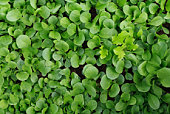
When planning the location of your kitchen or backyard garden, remember, realtors have it right; location is everything. Ideally it should be convenient enough to your house so that to you can visit it easily and as often as necessary. The old adage - Out of sight, out of mind ... applies in this case
Other considerations would be:
* Access to a water supply, such as a water spigot or hose bib is absolutely necessary.
* It should receive at least six to eight hours of full sunshine daily. Some crops can tolerate partial shade, but no amount of food, water or care can replace needed sunshine. Avoid nearby trees, not only because they will shade your plants, but they also absorb huge quantities of the soil's moisture.
* It should be fairly level with a slight slope of about one and a half degrees to the south if possible; this is particularly helpful in colder climates as it will help early crops get started.
* The plot should be well drained, and not in a location where water collects after a heavy rain. Drainage may often be improved by installing agricultural tile, digging ditches and sometimes by plowing or digging deep into the subsoil.
* Air ventilation is also critical with clean air flowing over your site to keep the danger of early spring or late fall frost damage to a minimum. A windbreak, however, such as a fence or a row of shrubs, will help if your site is subject to strong winds.
Fertile, deep, friable and well drained soil is necessary for successful gardening. The exact type of soil is not as important as that it be well drained, well supplied with organic matter, retentive of moisture, and reasonably free of rocks and stones. The kind of subsoil also is highly important. Rock ledges, gravel beds, very deep sand, or hardpan under the surface soil is likely to make the development of high-grade arable soil extremely difficult or impossible to obtain. On the other hand, infertile soil that has good physical properties can be made productive by using organic matter, fertilizer, compost and other soil amendments.
If the space available does not meet all of the above criteria, consider the many advantages of the raised bed system of gardening. By utilizing a modular raised bed gardening system, you can create a system of beds that are not as dependent on subsoil conditions and can be located where drainage and growing conditions are better. Other advantages are smaller beds can be worked on with less bending over, the smaller scale makes weeding and upkeep more manageable and by eliminating the need to walk on the bed, the soil will not compact and will promote larger and better yields.
Above Ground Vegetable Garden
There are no second opinions about the fact that vegetable gardening is a much more satisfying experience than any other form of gardening. This is more so because one gets the opportunity to relish the dishes made out of ones own produce. However, vegetable gardening is also not as easy as other types of gardening and one needs to plan well in advance, even before starting tilling the ground for the seeding purpose.
1. One important factor that needs consideration while planning is the climatic conditions. There are some vegetables that can be cultivated only in a certain type of climate and season. For example, Brussels sprouts, cabbage and broccoli can only be grown in cold areas, whereas, peppers, eggplants and tomatoes grow better in hot and sunny weather.
2. Another gardening tip that can be effectively used is that there are certain kinds of vegetables that do very well if exposed partially to sunlight. For example, lettuce is a plant that grows fantastically when exposed to sunlight for half a day and then kept in shade for the remaining half. One should plan the placement of ones vegetables in the garden keeping such factors in mind. Other vegetables that grow very well under partial exposure to sunlight are carrots, spinach, cauliflower, cucumbers, Swiss chard, radishes and beets.
3. Is your garden located in a region that either has a very long growth season or a very short one. Based on its weather conditions, a garden can be cultivated with the help of the following gardening tip. Gardens with long growth season are apt for growing vegetables like tomatoes, beans (lima, soy and dry), artichokes, celery, peppers, potatoes, asparagus, rhubarb, eggplant, onions, kale and leeks. Whereas, the gardens located in short growth areas must have vegetables like beets, cabbage, carrots, turnips, beans, peas, radishes, peas, mustard greens, onions and lettuce.
4. The next significant gardening tip is based on your level of expertise as a gardener. If you are a beginner, you will do much better by growing vegetables like beans (dry and green), potatoes, squash (summer and winter), radishes, tomatoes, beets, salad greens, beets, sunflowers, lettuce, Swiss chard and any other root crop, that don't offer great challenges and put you off in no time. In case you are a seasoned gardener and wish to take on the challenges, you can try your hand at celery, watermelon, parsnips, leeks, cantaloupe, Chinese cabbage, cauliflower, leeks, peas and corns.
5. At the time of planning for your vegetable garden, you must also include the space constraints that certain vegetable plants may impose. Some vegetables can do with minimum space while others may require yards and yards to come good. This gardening tip will help you classify the vegetables by the space that they require to grow. Vegetables that consume maximum space are artichokes (globe), cauliflower, cucumbers, peas, potatoes, winter squash, broccoli, corn, melons and sweet potatoes. Least space consuming vegetable plants are beets, Chinese cabbage, tomatoes, eggplant, lettuce, radishes, mustard greens, parsnips, beans (bush and pole), carrots, turnips, Swiss chard, leeks, sunflowers, peppers and onions. You must take care while planting these vegetables that you leave enough space for you to move around in the garden.
It is strictly advisable to not to use any chemicals in your vegetable gardens to get rid of weeds and insects. There are several organic methods that can be used without employing chemical herbicides and pesticides. Use of such chemicals kills both the good and harmful bugs in the vegetable garden. Moreover, the chemically exposed vegetables can have severe impact on the consumer health in the long run. You can always make use of a good naturally prepared mulch to get rod of weeds in your garden.
Both Richard Murray & Abhishek Agarwal are contributors for EditorialToday. The above articles have been edited for relevancy and timeliness. All write-ups, reviews, tips and guides published by EditorialToday.com and its partners or affiliates are for informational purposes only. They should not be used for any legal or any other type of advice. We do not endorse any author, contributor, writer or article posted by our team.
Richard Murray has sinced written about articles on various topics from Vegetable Garden, Home Management and Vegetable Garden. Dick Murray is a retired urbanite who keeps his passion for gardening alive with pots of herbs on the window sills and the creation ofweb site dedicated to. Richard Murray's top article generates over 2400 views. Bookmark Richard Murray to your Favourites.
Abhishek Agarwal has sinced written about articles on various topics from Surveys, Camping and Camping. Abhishek is a self-confessed Gardening addict! Visit his website http://www. Gardening-Master.com and download his FREE Gardening Report "Indoor Gardening. Abhishek Agarwal's top article generates over 368000 views. Bookmark Abhishek Agarwal to your Favourites.
Build Immune System Naturally It doesnt to much matter whether you choose to burn the essential oils as a vapor, use as massage oil, or use aromatherapy candles, just know that they will strengthen your immune system and try to ...