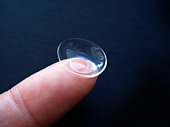
If worn longer than recommended or in people whose eyes are particularly sensitive, lenses may develop deposits on the surface of the lenses and cause irritation.
A major cause of blinding eye infections is spitting on a contact lens or putting the lens in one's mouth when no solution is available. This happens when a contact lens wearer must remove a lens or if a lens falls out of the eye and no solution is available. The best prevention is to have a small bottle of rewetting solution with you at all times. Never, never put your contact lenses in your mouth to lubricate them.
Some people use homemade or non-contact-lens saline solutions in an effort to save money. These solutions may cause severe irritation or blinding infections (some saline solutions are not sterile) and should never be used. Always use the correct contact-lens solution recommended by the fitter. If you want to change solutions, you should first check with your fitter because some solutions may be incompatible with certain lenses
It is not unusual to have some general irritation, even some redness, upon beginning contact lens wear. However, persistent redness, light sensitivity, pain, and blurred vision are the main signs and symptoms of potential eye problems. Depending on the cause, symptoms vary in intensity. In more serious infections, the pupil in the infected (red) eye may be smaller than the other pupil.
With a torn or broken lens or if there is something in the eye, there is usually a slight feeling of general irritation as if something is in the eye. There may be some associated redness.
With a poor-fitting lens or a lens that is old, there may be a slight irritation and redness associated with some blurring of vision.
Makeup on the surface of the eye or a reaction to solutions can vary from slight to marked redness of the eye with slight to marked pain.
Corneal abrasions (scratches) are usually quite painful, with or without the lens in the eye, and are associated with light sensitivity and redness. Vision may or may not be blurry.
Infections are a major concern because they may cause severe eye damage.
Simple pinkeye (a mild infection) is usually associated with redness, clear or mucous discharge, and matting of the eyelids. Vision is usually clear. When this happens, remove the contact lens in hopes of avoiding spread of the infection to the eye. Contact your fitter as to how to proceed.
Infections of the cornea are of more concern. These infections cause marked redness, light sensitivity, blurred vision, and a variable degree of pain. Occasionally, it is possible for the lens wearer to see the infection, which may appear as a white spot on the surface of the eye. These infections require immediate evaluation and care. Infections may be secondary to contaminated solutions, poor hygiene, contaminated tap water, or dirty contact-lens cases.
When a lens slips off the surface of the eye, vision immediately becomes blurry, which may or may not be associated with a sensation of something under the upper eyelid. If you can't move the lens to the correct position on the eye, you might have to seek the advice of your fitter.
Contact Lens Special Effects
If you experience redness, blurred vision, pain, or light sensitivity, you should contact your ophthalmologist or optometrist. (If he or she is not allowed by state law to treat eye problems, he or she will refer you to a practitioner who can handle these problems.) Normally, you will need to be seen that day. If you need to seek help, it is best to try to contact your eye doctor during the day, rather than waiting until evening or late at night.
Most ophthalmologists are available 24 hours a day via their answering service. If your ophthalmologist is not available, you should be seen by the ophthalmologist on call, or go to a hospital's emergency room.
Optometrists and opticians may or may not provide 24-hour availability. If not available, you should ask about the routine if a problem develops, especially after regular office or store hours. Many have an ophthalmologist to whom they refer medical problems; others may tell you to go to a hospital's emergency department. Recognize that emergency departments usually do not have an ophthalmologist on site.
Because of the specialized nature of eye examination equipment, contact-lens problems are best handled in the ophthalmologist's office.
Diagnosis and treatment of contact lens problems entail a complete history and an eye examination.
During the history, you are asked questions about your symptoms and how long you have been bothered by these symptoms (for example, light sensitivity, redness, blurred vision). You should also be prepared to tell your eye doctor about the type of contact lenses being worn (soft, gas permeable, or the older hard lenses).
What type of care regimen you use (cleaning, disinfecting, and rinsing solutions). This should include the specific name (manufacturer) of solutions. The type of wear regimen used: daily disposable, weekly overnight wear, or daily wear. How often the lenses are replaced (daily, weekly, monthly, quarterly, or yearly).
The examination of the eye involves checking your vision (with your glasses because you have removed your contact lenses).
If your vision cannot be corrected, your eye doctor may suspect the presence of a serious problem.
Your eye doctor looks into your eye with various types of lights, starting with a flashlight type of instrument and followed by a slit lamp (a microscope to examine the eye with high magnification and different color lights).
Your eye doctor may place a dye called fluorescein on the eye. This makes abrasions and ulcers show up clearly.
With apparently severe infections, cultures of the eye may be taken and sent to the laboratory for evaluation. Depending on the cause of the infection, specific antibiotic eyedrops may be required. Rarely, hospitalization is required.
If you experience irritation, pain, blurred vision, redness, or light sensitivity, immediately remove your contact lenses and re-evaluate your symptoms.
Because you should not wear your contact lenses when experiencing these problems, you should have an up-to-date pair of glasses for these times. With well-fitting contact lenses, you should be able to remove your lenses and see well with your glasses, essentially immediately.
Blurred vision, lasting for hours, upon removal of the contacts is usually a sign of poorly fitting contact lenses. If your vision is blurred, with your glasses, when lenses are removed, notify your fitter.
Alisha Dhamani has sinced written about articles on various topics from Web Development, Careers and Job Hunting and Health. Jigfo.com is a source of global information. Learn and share knowledge with thousands. http://www.jigfo.com. Alisha Dhamani's top article generates over 18100 views. Bookmark Alisha Dhamani to your Favourites.
Best Practices Internal Communications With a complete and accurate database in place, a telecom Expense Management TEM system can realize significant savings and pay for itself in short order