Some wearers of contact lenses may be tempted to save money by taking hygienic shortcuts when it comes to keeping their contacts clean. Instead of buying cleansing solution for their lenses, they may decide to rinse them with plain water or even attempt to use a homemade solution. While a few dollars may be saved by taking this nonchalant approach to cleaning the contacts lenses, the possible harmful consequences far outweigh the financial benefits of adopting a do-it-yourself mentality.
The problem with homemade concoctions is that these will lack anti-bacterial efficacy ? harmful bacteria will continue run rampant on contact lenses and can cause serious medical complications if the eyes become infected.
A corneal ulcer is an open sore or non-penetrating erosion in the transparent area at the front of the eyeball ? the cornea ? and is associated with infections caused by bacteria. This is exactly the kind of bacteria that freely grows on contact lenses when homemade solutions are substituted for commercial cleansing solutions. Corneal ulcers can also be precipitated by wearing soft contact lenses overnight.
Those who attempt to use their own homemade cleaning solutions also run the risk of contracting Acanthamoeba keratitis. Acanthamoeba is a water-borne, microscopic parasite that can wreck havoc in the form of an infection when it invades the cornea. While using homemade solutions are often the cause, swimming in lakes and swimming pools while wearing contacts can also trigger the condition.
The symptoms that accompany this infection are intense pain and redness, and those afflicted with the infection are often hospitalized. If corneal scarring results, a cornea transplant may be necessary. Treatment and therapy may last a year or more, and sometimes severe vision lost can be the outcome of a bout with Acanthamoeba keratitis.
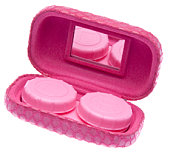
It's crucial to remember that accessories like the lens cases for contact lenses must also be kept clean in accordance with the manufacturer's instructions. These instructions will specify what cleansing solution to use or may even specify that the use of hot tap water to clean the lens case is permissible. A case that isn't properly cleaned can be a breeding ground for bacteria in the same way that improperly cleansed contact lenses can be. Eyecare professionals suggest discarding cases every three months or so and replacing them with new ones.
The good news is that the risk of contracting Acanthamoeba keratitis can be minimized by adopting these simple measures:
*Avoid the use of homemade cleansing solutions
*Make sure you use commercial cleansing solutions
*Make sure you clean the cases for your contacts; discard and replace the cases every three or four months
*Be aware that sometimes wearing soft contact lenses overnight can cause infections for some people
*Be aware of all factors that may cause infections and medical complications, such as wearing contacts while swimming in lakes, pools or the ocean
Don't allow destructive bacterial to build up on your contact lenses and in your cases. Eye-damaging conditions like A keratitis can be held at bay by following a simple set of hygienic procedures that will help to ensure that your eyes stay healthy and infection free.
Copyright 2006 Daryl Glenn
Contact Lenses By Mail
About 20% of Americans war contact lenses to correct their nearsightedness (myopia), farsightedness (hyperopia) or astigmatisms. Others prefer eyeglasses or refractive surgery. If you have been wearing glasses for a long time, you may not wish to be seen without them, because they have come to form part of what you and other people recognise as your face. They can be, after all, a fashion statement.
One major advantage of contact lenses is the all-round vision they provide, which is especially important for those who practice a sport regularly. You may be surprised to hear that contact lenses have been with us for almost a century. There have been many changes and advances since those early days and the chances are that if in the past you have been told you could not wear contact lenses, this is almost certainly no longer the case, because there are now contact lenses adjusted to fit just about everyone’s needs.To be assessed and fitted for contact lenses, you will need to see an eye care professional (ECP), such as an optician or ophthalmologist, to get a prescription. The kind of thinks an ECP will be assessing you for are your visual needs, the structure of your eye and your tear production.
Lens design and materials vary, as does the length of time you can wear them for. There are basically three types:Hard lenses, made from Plexiglas or Lucite, are all but obsolete because of the kinds of irritations they used to produce. Soft lenses, introduced on the market in 1971, are the most frequently prescribed. They are made from a gel-like substance which is a plastic containing water, and are slightly larger than the iris. More recently, silicon hydrogel contact lenses have become available. These are the preferred choice for ECPs, because they allow for a better supply of oxygen to the eye and do not cause dehydration. The lens of choice for presbyopia and high stigmatism are RGP lenses, made from rigid plastics, which are oxygen permeable. At about 8mm diameter they are smaller than your iris.
People used to have to take their contact lenses out at night, but since the introduction of extended wear in 1979, this is no longer the case. There are now three kinds of lenses, daily wear and extended wear, which can be worn up to seven days in a row, plus continuous wear, which can be kept n for a month at a time.
The reason contact lenses need replacing regularly is that tears naturally contain lipids and proteins. These can adhere to the lens, forming a build-up which can cause irritation and even lead to infection.Ocular hygiene helps and there are very good cleaning products for this purpose. Nevertheless, eventually the lenses will need replacing. So-called disposable lenses take care of this, whether they are replaced every day, once a week or every two weeks, or monthly. If you go to http://www.contact-lenses-reviews.com , you will be able to find more information about contact lenses.
One final point is that bifocal and tinted contact lenses are also available. Your EPC will assess your vision and advise you on which kind of lens would be best for you.
Both Daryl Glenn & Kelly Hunter are contributors for EditorialToday. The above articles have been edited for relevancy and timeliness. All write-ups, reviews, tips and guides published by EditorialToday.com and its partners or affiliates are for informational purposes only. They should not be used for any legal or any other type of advice. We do not endorse any author, contributor, writer or article posted by our team.
Daryl Glenn has sinced written about articles on various topics from Anger Control, Collection Agencies and Acne Treatment. The author, besides having worn contact and corrective lenses all his life, is a researcher and writer with a number of publications in university journals. His website,. Daryl Glenn's top article generates over 2400 views. Bookmark Daryl Glenn to your Favourites.
Kelly Hunter has sinced written about articles on various topics from Protein Diet, Anger Control and Eyewear. Kelly Hunter operates http://www.contact-lenses-reviews.com and writes about Contact Lenses.. Kelly Hunter's top article generates over 6600 views. Bookmark Kelly Hunter to your Favourites.
Best Prices On Products By making sure you choose inexpensive items, do not gouge customers, and buying supplies in large quantities for cheap prices, you can entice your customers to return and become regulars in your esta...