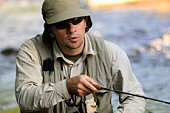
There is a great debate in the fishing world as to whether fly fishing enthusiasts and regular anglers should be grouped together and use the same terms. At first glance, it would seem so. In truth, people that gravitate to fly fishing tend to stick solely with it. This, of course, has resulted in the development of a language all their own. Often, the language actually contradicts some terms that have other meanings in the traditional fishing lexicon.
Action is a word generally understood to mean whether the fish are biting or not. If they are, the action is good. If they are not, well at least you are not at work. In fly fishing, however, ?action? is usually used to refer to the pace a particular fly rod casts a line. Stiffer rods tend to cast lines faster and farther while rods that bend more tend to cast lines slower and shorter distances. If you tell a fly fisherman that the action was good at the river today, they will start looking at your rod instead of asking you about your tally.
Affluent is another term that has taken on a unique meaning in the area of fly fishing. No, it does not refer to someone being able to speak another language. It also does not refer to the size of their bank account. Instead, it refers to a particular type of stream ? one that flows into a bigger body of water. Understanding this can help you avoid a lot of confusion when people start talking about an affluent.
Perhaps the most obvious area where language has run amuck is, well, the flies. If you hear an odd name that sounds like slang, it is most often referencing a particular type of fly. A fly, of course, is your ?bait?. It is almost always a man made hook with all manner of things tied onto it. In general, one is trying to create something that looks tasty to fish that hunt flies and insects. Common, if odd, fly names include Wooly Bugger, anything with the name nymph following it and the famous Frankenfly. A Frankenfly is what you get the first time you try to make your own fly. It will be horrific, but you will love it since it is yours. You might even frame it.
Obviously, this is a relatively modest introduction to the language of the fly fishing enthusiasts. The best way to learn it is to take ?action? to become ?affluent?.
Fly Fishing For Bonefish
Fly Fishing is a method of fishing that utilizes an artificial fly, a long flexible rod, a reel, and line. It is a very ancient and distinct angling method, developed primarily to catch trout and salmon but which is now being used to catch other species such as pike, bass, and carp, as well as a wide range of marine species. Artificial flies are crafted and then tied onto a hook with thread, fur, feathers and other materials in different sizes and colors to match naturally occurring insect or simply to attract a fish.
There are several standard method of presenting a fly to the fish using a fly rod and fly line which involves many different casts such as Fly Cast, Spin Cast, Back Cast, Forward Cast, False Cast, Roll Cast, 'S' Cast and Shooting Line.
The most commonly used being the spin casting and the fly-casting. In spin casting the weight of the trap pulls the line out of the reel. In fly-casting the weight of the line is enough to carry the fly to the fish. You must learn to use the rod to cast the weight of the fly line.
The line and fly attached to it goes in the direction you point the rod tip during the cast. Good fly-casting is nothing to do about strength but it is all good timing which comes from practice. You have to spend at least 15 minutes a day to become a good caster in a month.
Proper stroking and correct stopping of the rod are fundamental to good fly casting. The caster loads all energy into the rod during the casting stroke. The rod then releases this energy into the line in the cast. The caster puts a short, low-energy stroke, into the top of the rod for short casts; while he loads a short, powerful stroke, into the middle and bottom of the rod for a long cast.
Casting arc is the arc the rod makes in the air during the cast, which is small for short casts and large for long casts. Precisely stopping the rod after the casting stroke is critical to forming the casting loop and it allows the rod to unload, thus casting the line.
Fly fishers never need to cast more than 50 feet when fishing. Still becoming proficient at long-distance casting can improve all your casting. You should first learn to cast short distance i.e.30 feet and then practice at greater and greater distances.
Both Nomad Rick & Namsing Then are contributors for EditorialToday. The above articles have been edited for relevancy and timeliness. All write-ups, reviews, tips and guides published by EditorialToday.com and its partners or affiliates are for informational purposes only. They should not be used for any legal or any other type of advice. We do not endorse any author, contributor, writer or article posted by our team.
Nomad Rick has sinced written about articles on various topics from Aquarium Fish, Flying and Recreation and Sports. Rick Chapo is with NomadJournals.com - makers of fly fishing journals that make great unique birthday gifts.. Nomad Rick's top article generates over 49500 views. Bookmark Nomad Rick to your Favourites.
Namsing Then has sinced written about articles on various topics from Vitamins, Careers and Job Hunting and Allergies. NamSing Then is a regular article contributor on many topics. Be sure to visit his other websites Fly Fishing Vacation,. Namsing Then's top article generates over 60500 views. Bookmark Namsing Then to your Favourites.