Anyone who intends to purchase a digital camera may fall for the myth of high resolution. The resolution is the number of mega pixels the camera can produce and it is said that the higher the resolution, the better your photos will turn out like. This is indeed true for certain situations, such as when pictures are printed out on larger size paper. The truth is that for plenty of camera users the advantages of a high resolution camera are close to zero.
Let's start by understanding what a mega pixel means. Literally, it means one million pixels. A pixel is the tiniest part of a digital picture. If you have an application that you can use to zoom into an image you can really see those pixels - they look like the 'pixellated' effect you've seen on TV which hides people's faces. Each digital image, including your PC screen, is a rectangular made of pixels: the larger it is, the more pixels it has. You can find out how many pixels your monitor has in the display settings. For example, a 1024 (horizontal) x 768 (vertical) screen has 1024x768 pixels, meaning 786,432. This means a little less than 0.8 mega pixels. So if you look at an image with a higher resolution, the rest of the pixels just don't fit your screen and they are lost. You have to remember that you can never see more pixels than the screen can display. A 10 mega pixel image would be much resized to fit the computer screen and the remaining pixels would be lost. If your computer didn't do that, you could only see a small section of the picture and would have to scroll up and down to see the rest. When an image is zoomed out, the number of pixels is decreased. Viewed on the computer screen, an image which only has 0.8MP and needs no zooming out has the exact same level of detail with one of 12MP which has been zoomed out. To see for yourself, open two images of small and high resolution on your computer screen and see how they look like.
Many people never print their digital photos. They share them with friends and then store them on the computer to view them later. Most cameras found on the market nowadays are over 4MP, which is more than enough for your computer screen. If you buy a 12MP camera and only view the photos on the computer, the extra pixels are just lost. Moreover, higher resolution images take up more space on the memory card so you can hold fewer pictures. Not to mention the hassle to resize them when posting them on a website or sending them by e-mail. However, if you have a high resolution camera, you can adjust its resolution settings to take most of the pictures at lower resolution.The settings are either numbers or high, medium or low levels. If you choose a low resolution, you will be able to view your photos easier and upload them faster.
High Resolution Surveillance Cameras
Tired of trying to keep updated with the highest mega pixel resolution digital camera? Well even if one has tried to do that, most certainly he will soon find out that his few months old digital camera is outdated in terms of mega pixel resolution. It's an ever changing kind of product that has become very hard to keep updated, unless one is willing to spend more money by making purchases every six to twelve months.
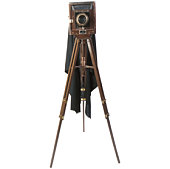
If the main intention of purchasing a photo camera is enlarging the image, then mega pixel resolution indeed will become the main factor. In this case one might consider a different option, which will keep his product updated for years to come. I'm talking about a used 4x5" film photo camera, together with a high resolution flat bed film scanner. All of this for less than one thousand US dollars. With all of this, one will get over 100 mega pixels in fine detailed film resolution and fine scanned digital images that can be enlarged up to 30x40" in size with professional quality. These 4x5" film cameras have done a remarkable job in general personal and commercial photography such as wedding, portraiture, product, documentary, advertising and landscape for nearly a hundred years.
Where to find 4x5" used film cameras? Since some of these cameras were mostly used in the past, until the 1960's, it should be no problem in finding them in American auction web sites. Anyway, a good used 4x5" camera with lens can be found for less than four hundred US dollars.
As for the flat bed film scanner, one can find brand new ones for less than five hundred US dollars. Just make sure the scanner is able to scan films.
Whenever purchasing a 4x5" film camera, one should look for the following features: folds into a compact box, flexible bellows, lenses that can be easily interchanged, accepts sheet film, ground glass focusing screen, easily handheld and optical viewfinder accessory.
As for the lenses, there are four main categories: 1 - general purposes; 2 - wide field (mostly used for close up work and landscape); 3 ? extreme wide angles lenses; 4 ? special effects lenses (telephoto). However, one might use a general purpose 127 or 152mm lens for most of his photograph sessions. In cases where it requires special lenses, such as architecture or macro photography, one will still find lots of them available in auction sites. Used lenses for 4x5? cameras made after world word II have excellent performances comparable to today's modern lenses.
Whenever making a purchase of a 4x5" camera make sure that: 1 - the bellows have no light leaks, 2 ? the lens shutter works accurate at all speeds; 4 ? the lens elements have no fungus and scratches of any kind; 4 ? the focus is working properly between the ground glass and the film.
The option of using a 4x5" film camera, together with a flat bed film scanner, for enlarging images with professional quality is viable and accessible. Cheaper than top digital cameras, the 4x5" film camera offers better image quality and will always be updated in the future, maintaining its original value.
For those who wishes the very most detailed image enlargement, one can always use the 8x10" film camera. Four times the physical film size of the 4x5", this option offers so much film resolution that it is considered by many as the ultimate step for photo image enlargement.
Sometimes analog products deliver better results that its digital counterparts. If you are doing the job of enlarging photo images, you should give it a try with a 4x5" camera. You might just surprise yourself.
Roberto Sedycias
IT Consultant
This article is under GNU FDL license and can be distributed without any previous authorization from the author. However the author's name and all the URL's (links) mentioned in the article and biography must be kept.
Both Alex Don & Roberto Sedycias are contributors for EditorialToday. The above articles have been edited for relevancy and timeliness. All write-ups, reviews, tips and guides published by EditorialToday.com and its partners or affiliates are for informational purposes only. They should not be used for any legal or any other type of advice. We do not endorse any author, contributor, writer or article posted by our team.
Alex Don has sinced written about articles on various topics from Computers and The Internet, Home Management and Computers and The Internet. Alex Don usually writes in the field of photo resizing at Reshade. The business works in the domain of image resizers providing a free online image res. Alex Don's top article generates over 135000 views. Bookmark Alex Don to your Favourites.
Roberto Sedycias has sinced written about articles on various topics from GPS Cell Phones, Writing and Movie Reviews. This article can also be accessed in portuguese language from the News Article section of page PoloMercantilRoberto Sedycias has a bachelo. Roberto Sedycias's top article generates over 1500000 views. Bookmark Roberto Sedycias to your Favourites.
Benefits Of Iso Certification This speeds up the process as well as makes it simpler and that too without making any kind of compromise on the quality and safety management system