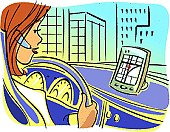
Whether you enjoy those afternoon cruises or that extended road trip on your bike, adding a GPS system to the ride will increase your adventurous spirit and will result in a lot more enjoyment. It opens up a brand new world for exploring some great places and you can download information and start planning your trip before you ever leave home. But before you invest in a motorcycle GPS system, here are seven things you need to consider before you tell that salesperson "I'll take it."
#1 - Decide which GPS unit is the right one for your bike. GPS units come three different ways:
- GPS/PDA hybrids
- portable outdoor units
- units designed specifically for your bike
So you see, the first consideration already involves three others. But for all practical purposes, if you also enjoy camping, mountain biking, or just exploring the outdoors, then the portable option is the best choice.
#2 - Find a motorcycle GPS unit that will meet your reception needs. When it comes to pinpointing your position, how accurate do you want the satellite signals to be? There are models available that come with WAAS (Wide Area Augmentation Systems) technology and can accurately pinpoint your position down to between 3 to 4 meters, but most will be accurate to within 6 to 8 meters.
#3 - Does the life of the battery in that GPS system meet your needs? Most GPS units use 2, 4, or 6 "AA" batteries and will usually function for about 6 hours. However, there are units available that can use rechargeable batteries instead, which in the long run usually proves to be more cost-effective.
#4 - Make sure the motorcycle GPS unit that you buy is durable. GPS units on bikes can take a beating on rougher roads and surfaces, so you want to make sure that the unit you purchase can withstand that kind of punishment.
#5 - Is 2-way communication an issue? Some of the more recently GPS systems on the market have elevated the concept of 2-way communication to a new level. The wireless internet for Bluetooth enabled phones can now interact with some of the newer motorcycle GPS systems on the market.
#6 - Find a GPS unit that is easy to update. Truer words for computers and related technology have never been spoken. Updates can be the life (or death) of numerous electronic devices that are computer operational and oriented. GPS units all get updated differently, so you need to pick a unit that doesn't give you a lot of grief when you need to download updates for it.
#7 - How much money should I budget towards the purchase of a motorcycle GPS system? The rule of thumb is to purchase the most expensive model you can afford that will also meet all of your demands and navigational needs. GPS units are as varied in price as they are in design and function, and only you will know the one that works the best for you and what your budget will tolerate.
Magellan Roadmate Gps System
The global positioning system (GPS) is a combination of many number of orbiting satellites. The basic objective of this is to provide precise positioning information that is useful for the navigation purposes. To calculate the positioning it uses the accurate timing information and triangulation. The accurate timing system is also used for the computer network time synchronization purposes. The orbiting satellites have onboard atomic clock that provides highly precise time. The GPS timing information is used to get the network timing with the help of GPS NTP servers. There are different types of equipments that are needed to process GPS signals for time and frequency applications.
Time remains same world wide and does not vary with the time zones and hence is referred to Universal Coordinated Time (UTC). The time send by the GPS satellite is not affected by the time zones and hence it continuously transmits precise time information. The GPS time is not affected by the leap seconds and is ahead of UTC time. That's reason for which you can adjust the GPS time to get the UTC time for the computer network time synchronization.
However, the GPS satellites broadcasts very weak low power radio signal with two frequencies, L1 and L2. The first frequency is intended as a civilian GPS band broadcast at a frequency of 1575.42. The later frequency L2 is intended to provide stronger signal transmission for the future. The signals can pass through glass, plastic and clouds and always move in a straight line though they can not pass through the metals and brickwork. That's why it is imperative to place the antenna in a place where it can face the clear sky. There are some ideal locations for it such as on the roof top and if it is impractical to place it on the roof top then you can place it in the side of a building or near a window.
As the GPS system provides subscription free accurate timing resource, many computer networks use this as an accurate timing reference for computer synchronization. The GPS reference clocks are utilized by precise GPS NTP server as an external synchronization source. The accuracy by the GPS system is enough for the computer network timing applications. The time and positioning information by the GPS servers is according to the standard NMEA protocol and usually they are transmitted as sentences of character strings. This is how the GPS system is used to provide the accurate timing for the computer networks.
Both Justin Stewart & Mark Williams are contributors for EditorialToday. The above articles have been edited for relevancy and timeliness. All write-ups, reviews, tips and guides published by EditorialToday.com and its partners or affiliates are for informational purposes only. They should not be used for any legal or any other type of advice. We do not endorse any author, contributor, writer or article posted by our team.
Mark Williams has sinced written about articles on various topics from Home Based Business, Shopping and Family. We have Network Time Servers for all your computer time Synchronisation needs. We have. Mark Williams's top article generates over 90500 views. Bookmark Mark Williams to your Favourites.
Blink 182 Drummer Travis Barker While they didnt come together as a threesome, DeLonge and Barker played under the moniker Boxcar Racer and Hoppus and Barker joined together for 44.