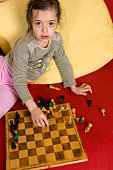
One day that I was old enough to understand the importance of strategic maneuvering when playing a game, my father decided that it was time for me to learn chess. Within a couple of months, I was carrying the chess board everywhere I was going, inviting friends to challenge my new game abilities. I still remember the reactions of those who have never been introduced to chess. They used to look me straight into the eyes asking me why they should waste their time playing such a difficult and boring game. I do not know even where to begin in order to describe what a beautiful game chess really is. With its variety of sacrifices and combinations, those who are eager to learn how it feels to belong to the winner's side can advance their gaming experience through chess. Having the opportunity to outwit your opponent either on the tactical or the positional level, chess is in fact a game that requires a constantly working mind. Perhaps it is "difficult" game, but this is the only way one can really be proud of the attained goal of winning a worthy opponent. Now in relation to the accusation of chess being boring, after playing chess frequently for more than ten years in a row, I really cannot describe how far away from the truth this statement really is.
First of all, if you are up to the chess challenge, you have to begin by learning the rules of the game. Being an abstract strategy board game, chess is played by two players on a square board that combines eight rows-called ranks -and eight columns-called files. Its simple design creates sixty-four squares of alternative color; one darker than the other. Each of the players is assigned to sixteen pieces (units) at the beginning of the game, which as the game progresses they are eliminated by the opponent's movements on the board. The object of the game is to checkmate the opponent. This practically means that one of the players has successfully managed to perform all the appropriate strategic movements so as to threaten the opponent's king from moving. It has to be stressed that due to the variety of the chess pieces and their distinct abilities on the game's board, chess has successfully become one of the world's most popular games.
Garry Kasparov and Robert Fischer-or Bobby-have been famous chess players worldwide, due to their exceptional abilities in combining the art of chess with the strategic maneuvering entailed in disciplines of science. Considered by many funs to be a "mental martial art," chess has gained its popularity among the nations of Asia, Europe and the Americas. Generally known as Western Chess or International Chess, to be distinguished from its many variations, the chess I was taught by my father is currently being played in a number of counties, some of which claim to have invented its original form. The most commonly held view is that chess originated in India, since the Arabic, Persian, Greek, Portuguese and Spanish words for chess all come from the Sanskrit game Chaturanga.
Currently, chess funs can be found anywhere from Japan to Sweden and chess players can locate their future opponents on the online forums and websites specifically designed to the pleasure of playing chess. If you are considering taking up the chess challenge, visit your local chess listings and you will be surprised of how many people are daily committed in exercising their mental abilities via a fun and instructive game like chess.
Mastering The Chess Openings
People, especially chess players themselves, utter the stupidest things about chess and about chess players. Here are a number of of our favorite misconceptions about the royal game. A few of these sayings are definitely untrue, some of them are uninformed opinion, and some of them are controversies that might or might not be true.
1) Chess is hard to learn.
Chess may not be the easiest game to pick up, but it is far from the most difficult. You have to have to learn the moves of the six pieces, where the piece with the least value, the Pawn, has the most complex moves. Then you have to learn the rules about attacking and defending the King, including castling. Then there are a small number of rules about games where neither player wins. One aspect of this myth is true ? it is hard, very hard, to learn to play chess well. One player in a hundred achieves supremacy.
2) You have to be smart to play chess.
There is some relationship between chess ability and general intelligence. Minimum smarts are required. Cats and dogs will never learn the basics; no one has tried teaching dolphins and chimpanzees. Chess does involve, after all, using various advanced compartments of the brain as skillfully as applicable. People from all walks of life have fun playing chess, many attaining mastery. Some very clever people delight in playing but never progress beyond novice rank.
3) Chess is for nerds.
As a matter of fact, this isn't a misstatement, because chess is for everybody. It is for dweebs, oddballs, eggheads, and boffins, as usually as it is for anyone else. People who need to call other people unpleasant names should better say, 'chess is only for nerds', but this is decidedly false. Even if it were true, so what? Intelligent, awkward, offbeat people have made more contributions to the advancement of society than have the rest. If they want to play chess, that's their business
4) Computers play chess better than people.
In 2006, the finest computing machines played chess better than 99.99% of people, but are evenly pitted in contests against the top humans. If, as some experts consider, computers are attaining 20 - 30 rating points per year, the time will soon come when humans have no chance against the best machines. It should not be omitted that computers are always checked by squads of human specialists who program them in psychological areas like opening repertoire. Removing this help would eliminate their excellence.
5) Chess is a sport.
Here we run the risk of upsetting the many outstanding chess organizers who have spent years trying to convince the International Olympic Committee (IOC) that chess should be admitted as an Olympic sport. Lifting little pieces of wood or clicking quickly on a computer screen is not physically demanding activity. As any quantity of photos from foregone high level chess events will demonstrate, chess players don't always cut a slim, trim, athletic profile.
6) Chess isn't a sport.
Here we try to make amends with those same organizers who almost convinced the IOC that chess is a sport. Chess has been admitted as a medal sport for the 2006 Asian Games. A contest between two top chess masters is full of tension, where good nerves can make the difference between a victor and a loser. Grandmasters have been known to lose a lot of weight during the action of a month-long contest.
7) Women can't play chess as well as men.
To date it is true that women have not performed as well as men in chess events. There are numerous conceivable reasons for this. One may be that male players are often expert at making female players feel ill at ease at chess events. The Polgar sisters have gone a long way to convince the chess world that women can play wonderfully. Maybe one day we will find out that women can even play better than men. No one truly knows.
Both Jonathon Hardcastle & Azlan are contributors for EditorialToday. The above articles have been edited for relevancy and timeliness. All write-ups, reviews, tips and guides published by EditorialToday.com and its partners or affiliates are for informational purposes only. They should not be used for any legal or any other type of advice. We do not endorse any author, contributor, writer or article posted by our team.
Desserts Recipes For Diabetics Bake until pumpkin is firm and crusts are golden brown, about 1 hour. Cool completely and serve. Garnish withWhipped cream or topping, if desired.Thats it, good luck and Happy Holidays