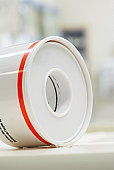
You have used it millions of times in your daily life, because of it you have been able to keep not only your food fresh and maintain a longer shelf life, but maintain your family safety. What is it, pressure sensitive tape!
Pressure Sensitive (PS) or pressure sensitive adhesive (PSA) tape is used in the home, office, industry, and institutions for a wide variety of purposes and occasionally applied to various printed products to allow part or all of a document to be attached to another document, folder, carton, package, plastic container, or a variety of objects. Pressure sensitive adhesives are designed for either permanent or removable applications. Examples of permanent applications include safety labels for power equipment, foil tape for HVAC duct work, automotive interior trim assembly, and sound/vibration damping films. Some high performance permanent PSAs exhibit high adhesion values and can support kilograms of weight per square centimeter of contact area, even at elevated temperature. Single sheets, multiple part business forms, labels, and mailers are among the printed products onto which pressure sensitive tape is often applied. Permanent PSAs may be initially removable (for example to recover mislabeled goods) and build adhesion to a permanent bond after several hours or days.
Pressure-sensitive tape'so-called because light pressure causes it to stick readily to most surfaces?typically consists of four component layers. Pressure sensitive tape will stick with application pressure without the need for solvent, heat, or water for activation.
Fundamentally, there are two types of pressure-sensitive adhesives used on the various assortments of tape - rubber-based and acrylic. Rubber-based adhesives were first patented in the United States; these rubber adhesives penetrate porous surfaces and after extended periods of time, become brittle, losing their adhesive quality.
There may be some limitations in the way that pressure sensitive tape is applied to printed products. Some examples include:
?PS tape cannot be applied perpendicular to the direction that the paper travels through a web press or collating machine. It may be possible for the manufacturer to apply the tape in a perpendicular direction with an offline process, but this may substantially increase the price of the product.
?It may not be possible to apply tape to the backside of a sheet that also has numbering on the front if the tape and numbering are applied in one operation while the document is being printed. The tape or the numbering could be applied offline, but this would increase the cost of the finished piece.
?Pressure sensitive tape cannot be applied diagonally.
Pressure sensitive tapes can be applied to the front or back of printed products. The adhesive side of the tape is applied to the document with the liner facing out. When the customer is ready to use the document, the liner material is removed from the tape to expose the adhesive, allowing the product to be attached to another object.
Consisting of a liner covering a double-sided adhesive, the pressure sensitive tape is wound into large rolls. Some types of printing equipment are able to dispense the tape from the roll so that it can be applied to the printed products as they are being printed. In addition, some collating machines are capable of applying the tape to multiple-part printed products as the various parts are being collated and attached by the equipment.
Pressure Sensitive Adhesive Tape
Adhesive Tape is also known as Pressure Sensitive Tape (PSA), Stick Tape and Self Stick Tape. Adhesive Tape consists of a pressure sensitive adhesive, this adhesive is coated onto a backing material, this material can be various different types like
Metal Foil
Paper
Cloth
Plastic Film
Some of these adhesive tapes have a removable liner; this removable liner protects the adhesive until it is removed and ready to be used. These layers can also be different some examples of what the layers can have:
Primers
Adhesives
Filaments
Printings
Easy Release Materials
They are all made for specific functions.
Adhesive tape does not require the use of a solvent, heat or water to help it stick, it does not require any other aid to activate it except for pressure. Once the tape is pressed against the desired item, the pressure on the adhesive tape will activate it and cause it to stick.
Adhesive Tape is used for a wide variety of purposes and is used commonly in Office, Institutions, Home and Industries.
There are two different types of Adhesive Tapes, Single Sided Tape and Double Sided Tape. Double sided tape is an adhesive layered on both sides of a material and then covered on both sides with a protective film. Double sided tape allows two items to be joined back to back. Single sided tape is manufactured the same way but only one side of the material has the adhesive on it. Single sided tape allows the joining of overlapping materials, the joining of two adjacent materials and allows bonding to a surface.
In 1845 a man named Dr Horace was the first person to develop Adhesive Tape and of all the professions he happened to be a surgeon.
The Varieties of Adhesive Tape
Gaffer Tape – this is usually based on a plastic tape or a heavy fabric, this tape gets its name from gaffers in the entertainment industry they used to use it to hold down cables to eliminate tripping hazards.
Masking Tape – This usually has a paper backing and is used by painters, it is used to help them cut-in. This tape is only designed to be pressed against an object for a short period of time.
Duct Tape – This is also known as Duck Tape. Duct tape has many different uses and is usually backed on to a fabric, this tears very easily and is good if you need to tear the tape you are using by hand.
Box Sealing Tape – This is used to close up packages; it is opaque or clear and can be printed upon. This is also known as Parcel Tape.
Electrical Tape – This tape does not conduct electricity and is made of materials like Vinyl.
Double Sided tape – This tape is used to hold two materials together, Contains adhesive on both sides of the backing.
Surgical Tape – This tape is used for wounds to help hold dressings in place, it is an adhesive bandage.
Both Sam Inci & Daniel Owen are contributors for EditorialToday. The above articles have been edited for relevancy and timeliness. All write-ups, reviews, tips and guides published by EditorialToday.com and its partners or affiliates are for informational purposes only. They should not be used for any legal or any other type of advice. We do not endorse any author, contributor, writer or article posted by our team.
Daniel Owen has sinced written about articles on various topics from Management, Cars and computers and the internet. About Author:Daniel Owen writes about Adhesive Tape. To know more about. Daniel Owen's top article generates over 22200 views. Bookmark Daniel Owen to your Favourites.
Consolidate Debt Credit Debt Management It is a good practice to check if such businesses are registered with the Better Business Bureau BBB and whether or not they are in good standing