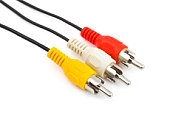
The basic components of a cable are: the conductor, shielding, and the connector. The primary goal of any cable is to transfer a fully preserved signal from its source to the destination. Even the best cables loose some signal strength. The loss is caused by outside interference, such as radio frequency and electromagnetic interference. Low quality cables provide least protection from this interference while high quality cables keep away such interferences.
What types of video cables you choose, it should maintain the clarity, dynamics, and power of the original signal. TV screens and DVD players are capable of great detail and clarity. To ensure the best picture quality you should choose cables that don't want lose part of the signal. The two main categories of video signals are analog and digital. Analog has been the standard for long but the improvements in technology have produced high quality digital sound and image that revolutionize the quality of pictures and sound we see and listen.
Here is the description of some of the best video cables you can choose for your video equipment.
DVI Cables
Digital Video Interface is relatively new. It offers a high-bandwidth digital-to-digital video connection that provides unmatched video quality. DVI is capable of maintaining the video signal in its purest digital form, obtained from satellites and DVI-equipped DVD sources to the monitors or projectors.
HDMI Cables
High-Definition Multimedia Interface is a more evolved version of DVI cables. It provides greater bandwidth than DVI and transmit higher-definition uncompressed digital video signals. It has a smaller and sleeker connector than DVI. HDMI connections are equipped with the High Definition Content Protection (HDCP) protocol.
Component Video Cables
Component video cables are the best non-digital cables for high definition video. These cables break down the video signal into three cables, thus enhancing the image clarity and sharpness. They look just like the composite cables but provide larger clarity. Both of them use RCA type connectors.
Composite Video Cables
Composite video cables use an RCA-type plug and jack. It is a direct video connection and is superior to the RF type of connection but inferior to S-video and component video. However all video signals are carried on a single conductor, which is not the ideal form of transmission. Usually composite video cables are sold bundled with a pair of stereo audio cables for convenience.
S-Video Cables
S-video cables are considered much better than composite video cables. These cables break the video signal into two component parts and greatly improve picture quality. These days S-video inputs are found on most high-end TVs and AV components.
RF Coaxial Cables
Though RF coaxial cables are the most common but the least desirable for AV connections. Both the audio and video signals are 'modulated' onto one cable, thus making it impossible to transmit high quality signal.
Coaxial RF cable connects your cable box or digital satellite box to your TV. It can also be used to connect a VCR to your TV.
Video Camera Buying Guide
The origin of canoes is as old as civilization itself. The American aborigines were said to be one of the early users of canoes. They use tree trunks as the main part of the canoe or the hull, fastened with sap, and stitched with tree roots. These primitive types of canoes were popularly known as dugout canoes.
A canoe is a human- operated miniature boat. This means that humans need to exert extra effort in paddling to travel using the canoe.
Unlike rowing, paddling requires the paddlers to look towards the course of travel. Paddlers are propped up on either side of the hull. Rowing, on the other hand, requires the rowers to face on the opposite direction of the course of travel.
Canoes were primarily used as a means of transportation. Of course, as modern technology has developed the varieties of substances to be used in making canoes, their functions had evolved as well. Today, canoes are also used in competitions and recreational activities.
Canoes can offer a great deal of entertaining and relaxing time with your family. Best of all, you can even get close to nature by paddling through the tranquil waters of the area and observe the wilderness on its natural state.
As much as canoes seem to be the easiest water equipment in the world, buying them may not look so simple. Remember, canoes may give you various benefits depending on their particular functions.
For instance, an aluminum canoe may be more durable than canvas canoe. Hence, aluminum canoes are for rough water adventures.
Given all that, it is imperative that you know how to choose the kind of canoe that will best work for you. Go after these principles in buying canoes to find out that type works best for you.
1. Know what you want
Before, canoes were primarily made and used as a means of transportation. Today, canoes are typically classified according to the way people want to make use of them.
For this reason, buying a canoe can be very tricky. If you are not yet sure why you want to buy a canoe, it is best to forego purchasing one first. You may not be aware of it but buying a canoe without a clear plan of what you want to do will only bring cause you problems.
For instance, if you are planning to take your family on a weekend nature trip across the lake, it is best to buy a canoe made of canvas. This is perfect for shallow, calm waters in the lake. With this kind of canoe, you and your family will surely enjoy the breathtaking view of the rough country.
2. Be wary of sizes, shapes, and length
Canoe dimensions can greatly influence the performance and function of a particular type of canoe. For example, a longer canoe can travel faster than the shorter ones. Flat- bottomed canoes provide exceptional primary strength and steadiness. Also, of course, bigger canoes can accommodate more weight compared to the regular ones.
So if you need a particular feature, it is best to consider the dimensions of your canoe and see for yourself if it will best work for you.
3. Never buy a canoe with a keel
It does not necessarily mean that keels are bad. The only reason is that keels will reduce the canoes capability to speedily maneuver the canoe to stay away from barriers or hurdles. That is why, it is better to use keeled canoes on open water or lake trips.
So the next time you want to buy a canoe, it is best that you buy a canoe without a keel to facilitate manual control.
4. Do not believe on load amount as advertised
This does not necessarily mean that there is no truth on the advertisements. What is being pointed out is that these ads do not stand for anything of high- value because most of the weight is being held in the center.
When buying a canoe, just always remember that canoes with broader edges can float better while canoes with tapered ends are quicker.
5. Think about the depth of a canoe
The usual and ideal depth for a typical canoe is 12 inches, that is, for the simplest form of a canoe. Of course, depth may still vary depending on the desires of the users.
For instance, paddlers or a camper may desire for an improved feature. Hence, they can either wait for the next kind of canoe available.
Indeed, canoe buying is not an easy job, but it is never difficult either. You only have to consider these simple guidelines in buying canoes to get the best buys ever, and the rest, as they say, is history.
Both Kevin Bernard & are contributors for EditorialToday. The above articles have been edited for relevancy and timeliness. All write-ups, reviews, tips and guides published by EditorialToday.com and its partners or affiliates are for informational purposes only. They should not be used for any legal or any other type of advice. We do not endorse any author, contributor, writer or article posted by our team.
Kevin Bernard has sinced written about articles on various topics from Video. http://www.digitivity.com/cables-wires/. Kevin Bernard's top article generates over 1900 views. Bookmark Kevin Bernard to your Favourites.
has sinced written about articles on various topics from . . 's top article . Bookmark to your Favourites.
Batteries For Hybrid Cars One possible solution to this serious hazard put forth by the fire department in Texas is to place chocks under the wheels if it is not known whether the cars ignition is still on or not