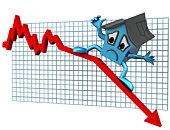
Yet again another fall in house prices! Is the doom and gloom in property market ever going to end? The short answer is yes but in our opinion not in the near future and certainly not in 2009. Figures from the major banks did show a rise in mortgage approvals in January but this was still 43% lower than the same time last year.
One of the major problems is that First time buyers are struggling to enter the market with the hefty deposits that lenders are asking for. For example a fifth of mortgage deals needing a whopping 40% deposit. This is compounded by the belief that house prices are due to fall further. So first time buyers generally don't have the deposits and are reluctant to enter a downward spiralling housing market.
With increasing repossession rates this bad news to those struggling financially. If you can't pay off your arrears the only way to avoid repossession is to sell your house fast but in the current economic climate this can be impossible.
According to Nationwide house prices have fallen by 17.6% in the last 12 months. Although there has been seen a slight increase in the level of business at Estate Agents and Property Auctions a full recovery in the housing market is not yet in sight.
Rapid Home Solutions provides home owners with a guaranteed quick house sale. It takes away the stress and ambiguity of the open market and can help people avoid repossession. Those who an accept an offer from Rapid Home Solutions have the peace of mind that in about 4 weeks their financial troubles can be solved.
Will House Prices Fall
All methods of predicting future price action rely on the same basic premise: prices are tethered to some fundamental value, and although prices may deviate from this value for extended periods of time, prices eventually return to fundamental valuations. This premise has been reinforced by market observation; in fact, many estimates of fundamental value are based on market action. Since many market participants believe in buying and selling based on fundamental values, there is also an element of self-fulfilling prophecy contained therein.
The efficient markets theory is based on this idea, and although the behavioral finance theory is needed to explain the wide deviations from fundamentals real-world prices exhibit, both theories share the same notion of an underlying fundamental valuation on which prices are ultimately based. The challenge to market prognosticators is to select a fundamental valuation to which prices will return, and then extrapolate a period of time in which the return of prices to fundamental valuation will take place.
There are a number of ways to project how far and how fast prices will fall. One is to look at the price charts themselves and try to project reasonable trend lines to approximate bottoming valuations. This is not an accurate methodology as it is based on the assumption of a repetition of past performance without examining the reasons for this past performance; however, it does serve as a useful rough estimate.
A more accurate and detailed method is to examine the variables that determine market pricing and see how changes in these variables impact resale values. This process involves assessing current fundamental values to make a statement as to where prices should be, and would have been if there had not been a residential real estate bubble, then estimating how long it will take for these variables to return to their historic norms.
There are a number of exogenous forces that act on market pricing in an indirect manner. These include debt-to-income ratios, availability of credit and changes in loan terms, mortgage interest rates, unemployment rates, foreclosure rates, home ownership rates, possible government intervention in the markets, and other factors. These forces do not directly impact house prices as changes in these variables do not have strong correlation with house prices; however, these variables can and do impact the variables that do correspond with house prices, therefore an evaluation is provided of the role these factors play in market pricing.
The timing of the decline is the most difficult parameter to evaluate and estimate. House prices are notoriously “sticky" during price declines because sellers are loath to sell at a loss. The timing of a decline is impacted both by psychological and technical factors. The motivations of sellers based on their personal circumstances and emotional states will determine if there is a heightened sense of urgency to sell which would push prices down quickly.
During the price correction of the coastal bubble of the early 90s, prices declined very slowly as unmotivated sellers held on and waited for prices to come back. The market experienced denial and fear, but there was not a stage of capitulatory selling that drove prices down quickly as is typical in the deflation of a speculative bubble.
The primary technical factor impacting the rate of price decline is the presence of foreclosures and real estate owned (REO). REOs are a form of must-sell inventory (as are new homes). If there is more inventory of the must-sell variety than the market can absorb, prices are pushed lower. The more of this must-sell inventory there is on the market, the faster prices decline. If the pattern of the early 90s is repeated, the price decline of the Great Housing Bubble may drag out slowly while fundamentals catch up to market pricing. In fact, this probably what will occur on the national market unless the foreclosure numbers and resultant REOs overwhelm market buyers.
In the extreme bubble markets like Irvine, California, the combination of high foreclosure rates and general market panic will likely push prices lower much more quickly. Even though the percentage decline in house prices is projected to be double the decline witnessed in the coastal bubble of the early 90s, the duration of the decline may be similar as capitulatory selling pushes prices lower at a faster rate.
Real estate market prices are difficult to measure accurately. By most estimates, prices will continue to drop at least through 2009, and most likely through 2011. Nationally, prices will drop around 30%, and in certain extreme coastal markets, prices will drop up to 50%.
Both Devk & Alex Gwen Thomson are contributors for EditorialToday. The above articles have been edited for relevancy and timeliness. All write-ups, reviews, tips and guides published by EditorialToday.com and its partners or affiliates are for informational purposes only. They should not be used for any legal or any other type of advice. We do not endorse any author, contributor, writer or article posted by our team.
Devk has sinced written about articles on various topics from Debts Loans, Car Accidents and Sales and Negotiation. The opinions expressed in all news articles are those of Rapid Home Solutions Ltd. The material is for general information only and does not constitute investment, tax, legal or any other form of advice. You should not rely on this information to make (or. Devk's top article generates over 8100 views. Bookmark Devk to your Favourites.
Alex Gwen Thomson has sinced written about articles on various topics from Home Management, Income Tax Return and Wrinkles. Lawrence Roberts is the author of The Great Housing Bubble: Why Did House Prices Fall?Learn more and get FREE eBooks at:. Alex Gwen Thomson's top article generates over 673000 views. Bookmark Alex Gwen Thomson to your Favourites.
20 30 Diet Plan Good luck with whatever diet plan you choose and I hope this list will help some of you to meet your diet goals